
Marie Earle
Continued onto: Marie Earle (post 1930)
The Marie Earle Institut Anglais de Beauté was established at 279 Rue Saint-Honoré, Paris in 1909. The name of the company was trademarked by a Madame Bernard, née Marie Bastable, so Marie Earle was a business name and the Mrs. and Miss Earle who ran the business were aliases.
Madame Bernard (née Marie Bastable) was actually born Janet Juanita Bastable [c.1852-1923] in Kanturk, Cork, Ireland. Her mother’s first name was Margaretta which suggests a Spanish ancestry on her side of the family and this may be why her daughter preferred Juanita over Jane. In 1874, Juanita moved from Ireland to France where, unmarried, she gave birth to a daughter – also named Juanita [1875-1937]. In 1877, in an attempt to give herself and her daughter a degree of legitimacy, the older Juanita was convicted for attempting to insert a false entry into the Le Havre marriage register for a union between herself and a Comte de Bernard (Le Figaro, 26 April 1877, No. 116, p. 2). Despite failing to have this ‘marriage’ recorded, Juanita clung to the Bernard surname, occasionally calling herself the Comtesse de Bernard, and referred to her daughter as Juanita de Bernard rather than Juanita Bastable. Further name changes followed.
In 1881, mother and daughter were to be found in Cookham, Berkshire, England where the older Juanita married Captain Robert Leslie Campbell [1843-1912] and became Mrs. Juanita Campbell. In 1892, the marriage ended in divorce with Juanita cited as having an adulterous relationship with Joseph Ebbsmith [1849-1899]. Three years later, in 1895, her daughter married the same Joseph Ebbsmith, a man more than twice her age, thereby becoming Juanita Ebbsmith. The marriage was short lived as Ebbsmith died in Spain a few years later.
The relationship between the two Juanitas and Joseph Ebbsmith is not necessarily a case of a man marrying his lover’s daughter. Though cited in the divorce case, Ebbsmith may have taken on the role of ‘adulterer’ to give the older Juanita grounds for divorce and then entered into a marriage of convenience with the younger Juanita to secure her name as the ‘de Bernard’ surname did not have any legal standing.
Whatever the situation, divorce and death meant that both women were unattached in 1900 which is perhaps why they went into the beauty business. Like many other women of the time, their entrance into the beauty business was through electrolysis. Two of their close relatives were doctors and it may have been via one of them that the women became ‘medical electricians’. They appear to have started practicing in Bold Street, Liverpool in 1901 but mother and daughter were also operating at 30 King Street, Manchester by 1903.
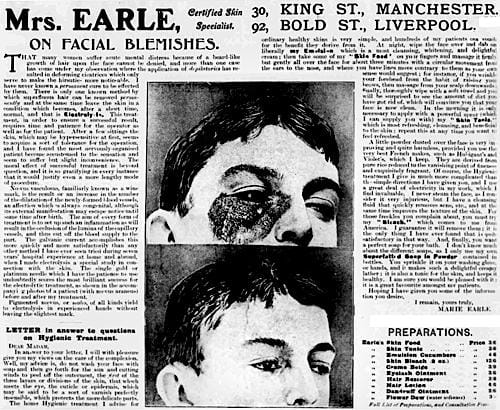
Above: 1903 Mrs. Earle – Certified skin specialist.
In addition to their tortuous past, there may have been another reason why the two woman decided to work under an assumed name. The beauty trade was then widely considered a dubious business. Other members of the Bastable family were doctors and solicitors so their reputations had to be considered. Why Earle was chosen is unknown but perhaps it was a feminisation of Earl, the English equivalent of Comte (Count), making it an echo of Juanita’s previous attempt to be a Comtessa (Countess).
Some records of the period list the two women as M. Earle and N. Earle. The M is probably for Marie (the mother), the name selected to suggest that she had come from Europe. The N may be for Nita (short for Juanita) the daughter. This was short lived and the pair soon became Mrs. Marie Earle and Miss Marie Earle.
Cosmetics
The two women did more than just provide electrolysis treatments. Their establishments also offered a range of hair-care and skin-care treatments and sold a range of cosmetics many under the ‘Perfection’ name.
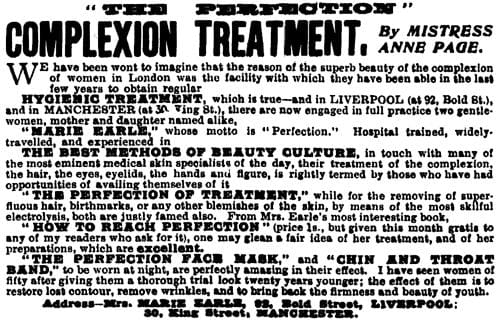
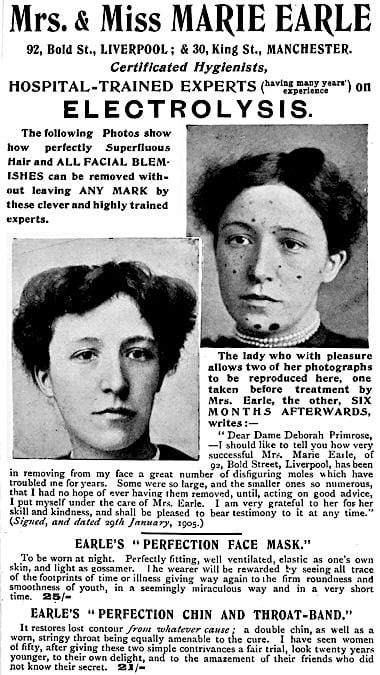
Above: 1905 Marie Earle complexion treatments: electrolysis, Perfection Face Mask and Chin and Throat Band.
In a 1926 interview, published in ‘The Evening News’ in Harrisburg, Pennsylvania, Miss Marie Earle remarked that the formulas for her cosmetics had come from her Uncle Herbert Bastable, a Trinity College, Dublin trained, skin specialist with offices in Harley Street, London. This refers to her uncle Daniel Herbert Bastable [1842-1908]. He was trained at Trinity and did work in London but I have no evidence that he was in Harley Street or practiced as a dermatologist.
At some stage, mother and daughter went into partnership with an E. M. Adams but this was gazetted as dissolved in 1910. By then, Mrs. and Miss Earle had relocated to France and opening the Institut Anglais de Beauté in Paris in 1909.
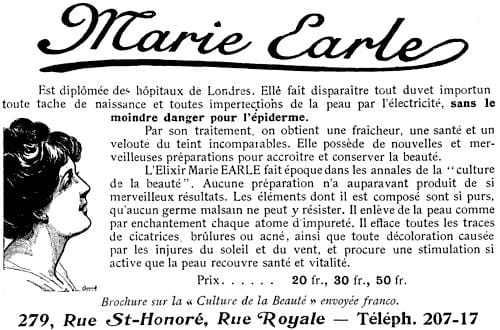
Above: 1909 Marie Earle at 279 Rue Saint-honore, Paris.
After the Earles moved to Paris their business in Britain underwent some changes. The Manchester salon seems to have closed by 1911, the one in Liverpool was moved to 71a Bold Street, and the management of Marie Earle in Britain seems to have been passed to Edendale Co, Ltd. I know nothing about this firm except that they opened a London agency for Marie Earle at 45 Upper Baker Street, London around 1913. All signs of Marie Earle in Britain come to a close shortly after this, presumably a casualty of the First World War.
Electrical treatments
Electrolysis to remove superfluous hair, port-wine stains and other birthmarks, enlarged capillaries, and assorted skin blemishes were an important source of income in the Liverpool and Manchester salons and this continued to be the case in Paris.
Marie Earle’s methods are the most advanced scientific and rational on all matters regarding the preservation and enhancement of physical beauty. She has perfected a system of Electrolysis for the permanent removal of superflous [sic] hair, birthmarks, scars, moles, redness of the nose and all blemishes of the skin. After ten years practical experience and a long (London) hospital training she is in a position to guarantee absolute satisfaction as shown by countless testimonials.
(Earle, c.1910, p. 1)
See also: Electrolysis
Marie Earle also used vibro massage to treat wrinkles and applied electric currents to revitalise tired eyes and strengthen facial muscles.
[E]lectric and vibro treatment is unsurpassed for giving firmness to relaxed muscles and tissue, natural freshness can be imparted to the complexion by it in a manner hitherto unknown, no matter how sallow, discoloured, or neglected the skin may be.
(Earle, c.1910, p. 1)
Skin-care
The Paris salon offered its clients a wide range of beauty preparations and treatments along well-established lines. Some, such as Earle’s Celebrated Skin Tonic used the Earle branding but most were given French names or badged with the Perfection label – e.g. Crème Perfection.
See also: Culture rationnelle et scientifique de la beauté
Like other Beauty Culturists of her time, Marie Earle suggested that frequent bathing, nourishing food, positive thoughts, and exercise would all help ward off the problems generated by city life and the sedentary lifestyle it created.
See also: Mrs. Pomeroy and Cyclax
Keeping the skin free from ‘impurities’ and other secretions that might block the pores of the skin was considered very important, and frequent bathing using one or more of Marie Earle’s bath preparations was recommended. These included bath salts and soaps, as well as an after bath lotion and a toilet powder. Advice from Marie Earle regarding soap was mixed. It was considered too harsh for delicate skins – a caution that was later extended to all skin types – unless it was one of her own.
Once the skin was clean, a range of therapies could then be used to deal with specific skin problems such as dry skin or wrinkles. Like other beauty establishments of the time, these treatments relied on combining skin creams with physical manipulations like massage and strapping.
Wrinkles and dry skin
Marie Earle considered that wrinkles were the result of ‘skin thinning’ and ‘lax muscles’ so recommended using skin foods and muscle oils combined with massage. These wouAs noted earlier, m5any of her preparations were given the title ‘Perfection’ and included: Crème Perfection, a general face cream; Crème Perfection de Jouvance Antirides, (later called Crème Perfection Antiride) for use around the eyes; Crème Baume, a night cream; Lait Amandes (Almond Milk) which was also useful for dry and damaged skin; and Huile de Jouvance, later Huile Perfection, a muscle oil that also had astringent properties.
Perfection Cream Antiride: “[A]n absolutely necessary preparation for the daily, thorough cleansing of the face, taking the place of soap and water, which are so injurious to an exposed surface. It keeps the skin soft and supple and preserves its lustre.”
Huile de Jouvance: “[D]evelops the tissues; a wonderful stimulant composed of fortifying plants, very toning, closes the pores. For use with wrinkle cream, to strengthen the flesh, the muscles of the face and throat.”
See also: Skin Foods and Massage, Wrinkles and Double Chins
Skin tonics
Marie Earle advised against ‘violent astringents’ which she considered harmful but she used them nevertheless to firm up the tissues of the face. The astringent was sprayed on clean skin using a small atomiser or a Lucas-Championnière Pulvériser. It was particularly recommended for oily skins as it helped to ‘close the pores’.
Earle’s Celebrated Skin Tonic: “Its bracing and healing qualities are unequalled. A truly refreshing preparation for giving firmness to the skin, distilled from herbs and flowers.”
See also: Skin Tonics, Astringents and Toners and Vaporisers
Skin blemishes
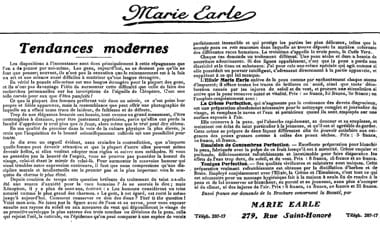
The Elixir of Youth, later known as Elixir Marie Earle, was used to treat acne and other skin blemishes. It was said to preserve and restore natural beauty so powerfully that ‘no woman need ever look old’. It contained ‘liquid oxygen’ (hydrogen peroxide) which ‘destroyed microbes, closed the pores and rendered the skin smooth and supple’. However, hydrogen peroxide is chemically unstable and would have dissipated fairly quickly in the jar, particularly if the lid was not screwed on tight.
Elixir Marie Earle: “[H]as been proved by thousands of women to make the skin proof against all vicissitudes of weather or climate, it is essential to those who wish that their skin should be clear, soft, smooth, and free from sallowness, discolouration of any kind, sun burn and freckles, free also from the blotches of acne and the disfiguring blemishes, attendant on it, for which the Elixir is an absolute cure.”
Cucumber creams were a common treatment for freckles and suntanned skin and Marie Earle also had one in her range (Emulsion de Concombres Perfection) to help keep the face and hands white.
Emulsion de Concombres Perfection: “Cooling and whitening, aids absorption and can be applied on top of the crème antirides.”
See also: Arsenic-Eaters and Cucumber Creams
Eyes
Marie Earle freshened the eyes by combining galvanic treatments with cold and lukewarm compresses, an hour-long procedure she described as a ‘new English discovery’ that lasted for weeks and was better than ‘the old practice of steaming and massage’. Perfection Ointment (Onguent Perfection) was used to promote the growth of eyebrows and eyelashes, and women suffering from red eyes – as for example after motoring – could use a Marie Earle Eye Tonic (Tonique pour les yeux) or Eye Drops (Les Gouttes merveilleuses) to help clear them.
Weight control
Marie Earle had both ‘flesh building’ and ‘flesh reducing’ creams in her product line. The fattening cream (Crème de Moelle) could be used to build up the chest, while the Lotion Réductrice could reduce excess fat on the rest of the body where slimming was needed. Women who wanted to just look slimmer could use the Marie Earle Perfection Belt. This acted like a girdle/corset to reduce the size of their waist.
Crème de Moelle: “[A] rich fattening cream to develop the contours of the neck and bust. a remarkable flesh builder. It transforms a thin scrawny neck into one that is plump and white and youthful. Pat it on the skin after cleansing. to quicken its effectiveness, leave some of the Creme on the skin overnight.”
Lotion Réductrice: “An excellent remedy for double chins and surplus tissue development in all parts of the body. Massage in morning and evening.”
Perfection Belt: “[A]bsolutely essential to every woman who wishes to have a figure moulded into such graceful proportions that she can appear to the utmost advantage in the clinging and elegant gowns of the day, they are specially made for each person, and are so formed as to reduce the size many inches without in any way causing inconvenience.”
Masks, straps, bands and belts
Women who could not come to the Marie Earle salon for a facial treatment could purchase one of Marie Earle’s Perfection Face Mask made from rubber or a Perfection Eye Band or Perfection Chin and Throat Band.
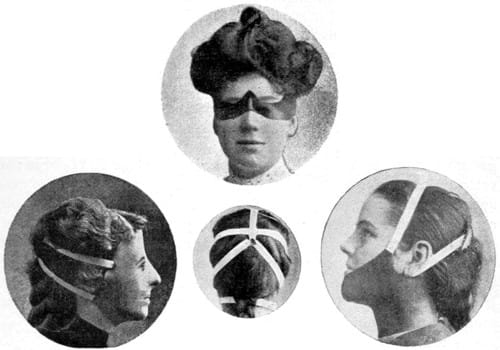
Above: Marie Earle eye, face and chin straps.
Perfection Face Mask: &rlquo;[S]oft and supple, fitting the face like a glove fits the hand, anything more successful does not exist in the beauty culture of our day. Nature's forces are so stimulated and the skin helped by the rational means provided by this perfection mask that the complexion is purified, beautified, and brilliancy imparted to it without any evidence of artificial means having been employed.”
Perfection Chin and Throat Band: &lduo;[R]emoves a double chin by bracing up relaxed muscles and drawing away fluid from the tissue, it makes the lower part of the face and throat firm, white, and shapely in a very short time.”
See also: Straps, Bandages and Tapes
Make-up
Marie Earle considered that a painted woman was an ‘abomination’ and an ‘affront to good taste’ but nevertheless considered that a judicious use of ‘cosmétiques’ was ‘harmless and permissible’.
Powders
Products in her range included: Blanc Gras, a foundation cream in White, and Rachel shades to be used under Perfection Poudre de Riz, a loose face powder in White, Cream, Rachel, and Flesh shades. For evening use there was Émail 77, a liquid powder and Earle’s Cream Niege, a powder cream both suitable for hiding blemishes and whitening the skin at night.
Blanc Gras: “[A] finishing creme to be used before powdering. Protects the skin and gives it a soft white appearance.” Shades: Blanche (White), and Rachel.
Poudre de Riz: “[D]elicately perfumed, will not clog the pores.” Blanche (White), Crème (Cream), Rachel, and Chair (Flesh).
Émail 77: “,An exquisite liquid powder made of the finest imported French ingredients, delicately perfumed. Unrivalled as a beautifier for evening use, but also very effective and becoming in daytime: hides all blemishes; looks perfectly natural on the skin. Absolutely prevents sunburn and freckles; waterproof lasting, does not rub off.”
Earle’s Cream Niege: “Composed of perfectly harmless ingredients. It obviates in one application brownness and redness of the neck and arms. It imparts a soft, natural whiteness to the skin; invaluable for evening use, and quite imperceptible.”
Some new lines were introduced after 1909, such as Eau Mystérieuse (1911). Its name, and the fact that it started out as a clear liquid but dried to a fine, white powder on the skin, suggests that it was made with a water-soluble analgesic called phenazone.
Eau Mystérieuse: “[A] transparent liquid which immediately imparts natural whiteness and bloom to the face, neck, and arms, which does not wear off. Apply without rubbing and allow to dry for about five minutes, then wipe the skin firmly with a piece of muslin. Invaluable for greasy skins.”
See also: Liquid Face Powders
Rouges
Marie Earle had a range of cosmetics for rouging the cheeks. These included Poudre Feuilles de Roses, and Perfection Feuilles de Roses Pour les Joules, both powder leaves in three shades as well as Perfection Feuilles de Roses, a liquid rouge. Marie Earle also sold Perfection Éclat des Lèvres, a lip balm which, I suspect, was coloured.
Perfection Éclat des Lèvres: Protects delicate skin from chapping and dryness, giving a very rich natural color that lasts despite bites and moisture.
Eye make-up
The previously mentioned Onguent Perfection which ‘strengthen’ eyelashes and eyebrows may have darkened them when applied. Specific eye make-up included Ombre des Paupières, a powdered blue-grey eyeshadow, and Crayons, eyebrow sticks in Noir (Black), Brun (Brown), Châtain (Auburn), Blond (Blonde), and Bleu (Blue) shades.
Ombre des Paupières: Oriental blue-gray powder to enlarge eyes, make them dark and bright, and at the same time give them charm and liveliness.
Expansion
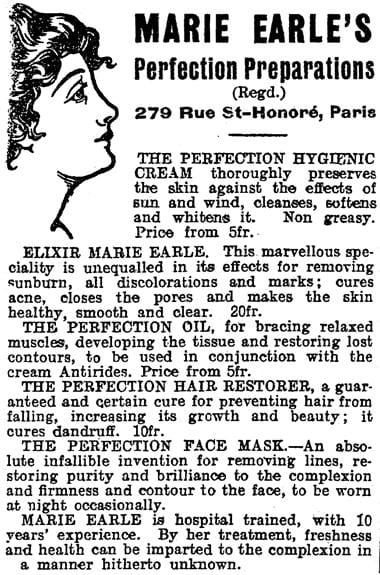
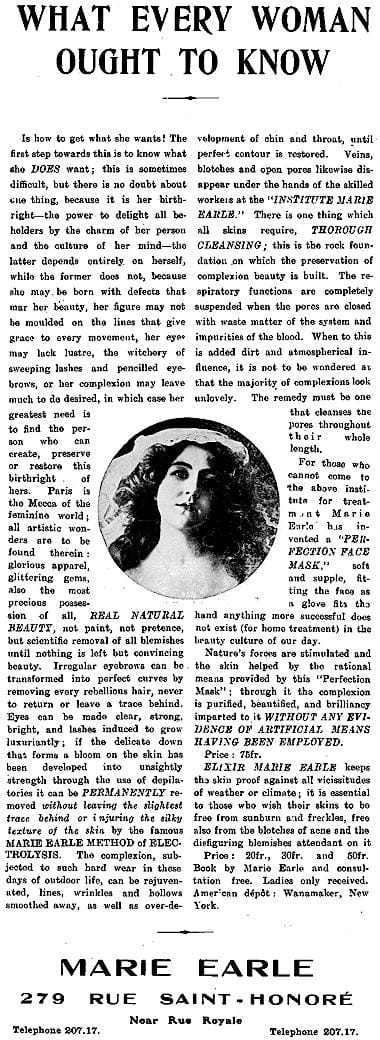
After the Institut Anglais de Beauté was opened Marie Earle paid for an extensive advertising campaign in the French edition of the New York Herald offering electrolysis and other beauty treatments to American women visiting Paris. By 1910, women returning to America could also find Marie Earle products in the Wanamaker department store in New York. Marie Earle established an American branch at 30 East 57th Street, New York in 1912 but a salon does not appear to have opened there until 1918 when mother and daughter relocated to New York. By then Marie Earle products were averrable through a number of department stores including B. Altman & Co., and Stern Brothers in New York, Jordan Marsh in Boston, and The White House, and City of Paris in San Francisco.
Not so long ago it was necessary to go to Paris to consult Marie Earle. And many women to whom money meant little and beauty much went to Paris for the privilege. Opinions might differ about the several great couturiers, but the beau monde was agreed upon the supremacy of one specialist. If one desired youth and loveliness, the order to one’s chauffeur was The Salon de Marie Earle. Several great American shops at the request of various women of society’s inner circle installed Marie Earle’s Preparations.
Then Marie Earle herself came to New York, upon the invitation of one of her clients and remained to establish a Salon. At first, she was here for only a brief season annually, now her personal services are available to American women throughout most of the year.(Marie Earle advertisement, 1922)
1920s
In 1922, Marie Earle incorporated in the United States with Juanita Ebbsmith as its president. By this time, the company had opened a second American salon at 1635 Connecticut Avenue, Washington. The New York salon had moved to 600 Madison Avenue in 1922, before relocating to larger quarters at 659 Fifth Avenue in 1926 and then across the road to 660 Fifth Avenue in 1927.
The salon in Paris was moved to 23 Rue Pasquier in 1922.Frech advertisements indicate that it was independently managed and it appears to have been abandoned within a year or two. The salons in Britain had long been closed but Marie Earle products were still on sale there until 1923 at least. However, all indications are that Marie Earle had abandoned its operations in Britain and Europe by the middle of the 1920s and was concentrating on building its business in North America.
In the United States, Marie Earle was initially promoted as French but these were gradually anglicised during the 1920s as America became its primary place of business.
Skin-care
Marie Earle considered that the extremes in the American climate might have a beneficial effect on the american personality but it was bad for the skin.
Three Adverse Conditions. The American woman has also to combat three natural conditions the extremes of climate, the swift changes of temperature, the prevailing dryness of the atmosphere. The severe winters and the brilliant summers are gloriously healthy. Even the swift changes of temperature and the electric dryness of the atmosphere have valuable qualities, for according to the “race-specialists” these conditions are the stimuli which have produced the national characteristics of dynamic energy, exuberant vitality, initiative, self-confidence, courage and generosity. But they certainly affect the complexion adversely.
(Marie Earle, 1925, p. 9)
Washing the face with soap and water was actively discouraged because it dried the skin and promoted wrinkles. Her skin-care routine followed the standard practice of cleansing, nourishing, toning and protecting with the occasional use of bleach to keep the skin clear and white. Ice and hot water were to be avoided.
Ice and very hot water are absolutely taboo! The shock to the circulation is unnatural and breaks the tiny capilliary blood vessels, making veins apparent and positively ruining the complexion. Even the contrast between indoor and outdoor air in winter is bad.
(Marie Earle, 1925, p. 35)
Instead of water, the skin was cleansed with Crème Antirides (Essential Cream) which was adveritsed as nourishing as well as cleansing. Emulsion de Conconbres (Cucumber Emulsion) could be applied over the Essential Cream to make the Essential Cream ‘twice as effective’. Both creams were applied with gentle finger strokes – to avoid stretching the skin – and any reference to the previous use of vibro massage disappeared.
Toning was achieve with the usual skin tonic/astringent , selected according onto the client’s skin type. Dry skins were to use Eau Antirides (Soothing Freshening Lotion); normal skins, Lait D’Amandes (Almond Astringent); and oily skins, Tonique Pour la Peau (Strong Astringent). As before, these were all best applied with an atomiser.
The treatment was then completed by protecting the skin with a vanishing cream, Marie Earle Finishing Cream (Blanc Gras), and powder.
BASIC TREATMENT No. 1—FOR AVERAGE SKINS
At Night
To Cleanse. Smooth a little Essential Cream (Creme Anti-Rides) all over the face and neck. Give particular attention to nose grooves, chin cleft and eye sockets. Remove with Tissues or a piece of old linen.
To Nourish. Apply the Essential Cream (Creme Anti- again with a little Cucumber Emulsion (Emulsion de Concombres). Stroke the skin until the circulation is gently stimulated. Leave cream on skin as long as possible. Before retiring remove most of the cream, only leaving on what can be absorbed over-night.
In the Morning
To Cleanse. To Nourish.. Before bathing repeat the Night Treatment. After the bath remove all the cream.
To Tone. Apply Almond Astringent (Lait d' Amandes) with an atomizer or with a piece of absorbent cotton first wrung out of cold water.
To Protect. Before powdering or making up, use the Finishing Cream, (Blanc Gras) on the face and the Liquid Powder (Email 77) on the face.( Marie Earle, 1924, p. 12)
There were also all the usual treatments for common skin blemishes such as blackheads, pimples, acne, pigmentation problems, and coarse and open pores.
See also: The Other Side of the Moon (1925)
Make-up
The biggest extension to the Marie Earle shade range came in 1928 with the addition of the Sun-burned Make-up shades – Ochre, and Sunburn – to accomodated the growing interest in suntanning. These were added to Marie Earle’s Finishing Cream (Blanc Gras), Liquid Powder (Email 77), Face Powder (Poudre de Riz) and Compact Powder. Ochre was recommended for white skins and daytime use, Sunburn for evenings or for women with dark skins.
Marie Earle continued to sell a Liquid Rouge in Light, and Dark shades but the rouge powder leaves seem to have been dropped in favour of the more practical paste and compact forms. Like the Marie Earle Liquid Rouge, the Paste Rouge only came in Light, and Dark shades but the shade range of the Compact Rouge was more extensive – No. 1, very pale rose; No. 2, a little more rose; No. 3, pale raspberry; Brunette B, most popular; Geranium, for fair skins, especially flattering by artificial light; and Orangette, for brunettes.
The Marie Earle Paste Rouge could be also used as an alternative to Marie Earle Lipstick which came in a gilt, twist-up case in three shades – Light, Medium, and Dark.
Marie Earle now sold a Liquid Eyelash and Eyebrow Darkener (Cosmetique Liquide) as well as a paste version (Cosmetique Paste) in Chestnut (Chatain), Brown (Brun), Black (Noir) shades. Both products were applied with a brush. Strangely there is no sign of the company developing a block/cake mascara. The eyelash darkeners would be combined with Eye Shadow Paste or Compact Eye Shadow Powder in Brown and Blue shades and Eyebrow Crayons in Chestnut (Chatain), Brown (Brun), Black (Noir).
Coty
Marie Earle began become increasingly profitable through the 1920s. Net profits were only US$247 in 1925 but this rose to US$20,944 in 1926, and US$31,260 in 1927 with similar results expected for 1928 when it was sold to Coty. After buy a majority stake in Marie Earle, Coty repackaged the line in 1929 and began reintroducing Marie Earle to France. Offices were established at 5 Rue Boudreau and a new Paris salon was opened at 15 Rue de la Paix in November, 1929.
Coty also used Marie Earle to distribute Rallet, a perfume line Coty had acquired in 1926. Rallet perfumes were sold through Marie Earle salons in the United States and some Rallet lines were specifically developed for Marie Earle, e.g., Rallet No. 1.
After the sale, Juanita Ebbsmith continued on as the president of Marie Earle but later retired and moved back to France. She died in 1937 at the Hotel Cosmopolitain in Cannes.
Timeline
| 1909 | Marie Earle salom opens at 279 Rue Saint-Honoré, Paris. |
| 1910 | Marie Earle company established in Paris. |
| 1912 | Marie Earle branches opened at 30 East 57th Street, New York and 45 Upper Baker Street, London. |
| 1918 | Marie Earle salon established in New York. |
| 1919 | New York salon moves to 600 Madison Avenue. |
| 1922 | Marie Earle, Inc., organised in New York. Paris salon moved to 23 Rue Pasquier. |
| 1926 | New York salon moves to larger quarters at 659 Fifth Avenue. |
| 1927 | Salon opens in Los Angeles. New York salon moves to 660 Fifth Avenue. |
| 1928 | Salon opens in Southampton, Long Island. Marie Earle bought by Coty. |
| 1929 | Marie Earle product line repackaged. New Paris salon opens at 15 Rue de la Paix. |
Continued onto: Marie Earle (post 1930)
First Posted: 22nd June 2015
Last Update: 21st July 2025
Sources
deNavarre, M. G. (1941). The chemistry and manufacture of cosmetics. Boston: D. Van Nostrand Company.
Marie Earle. (1933). Understanding your skin. The essential key to personal loveliness [Booklet]. New York: Author.
Jones, G. (2010). Beauty imagined: A history of the global beauty industry. Oxford: Oxford University Press.
1905 Mrs. and Miss Marie Earle – Electrolysis
1909 Marie Earle advertisment in the French edition of the New York Herald targeting Americans visiting Paris.
1910 Marie Earle (Paris). By now her products were also available in Wanamaker’s, New York.
1910 L’Elixir Marie Earle, La crème Perfection, Emulsion de Concombres Perfection and Tonique Perfection.
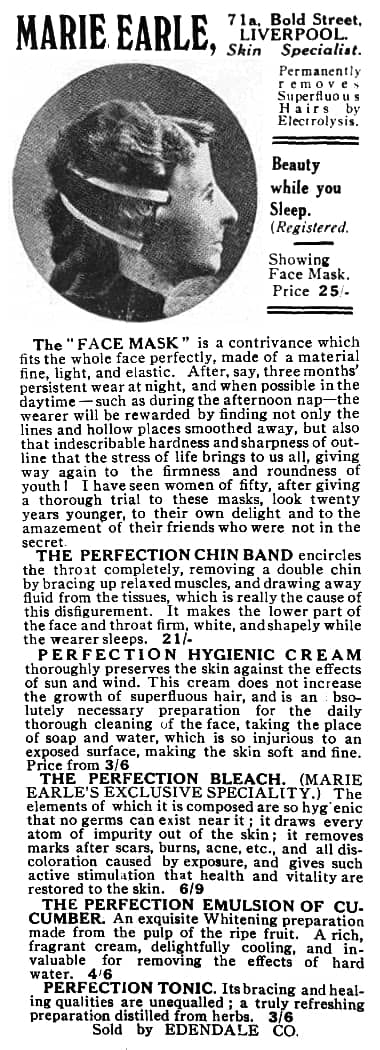
1911 Marie Earle.
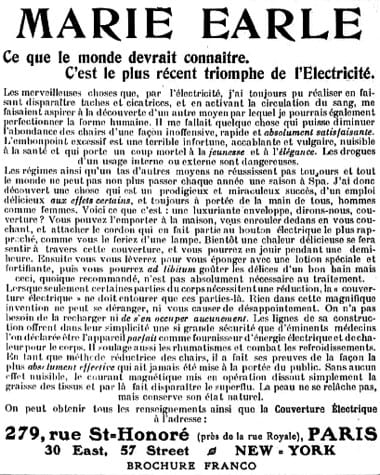
1912 Marie Earle. The company is now listed at 30 East 57th Street, New York.
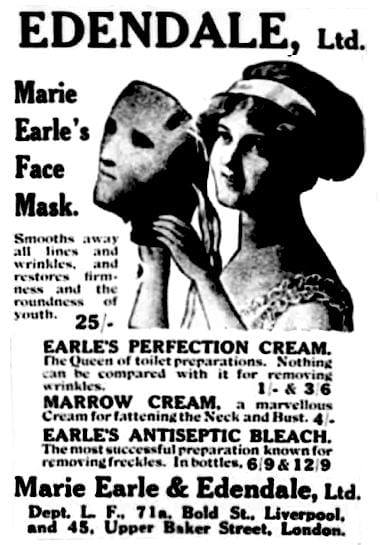
1913 Marie Earle and Edendale, Ltd.
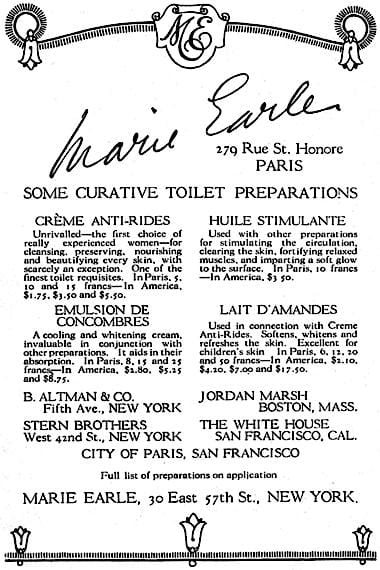
1918 Marie Earle.
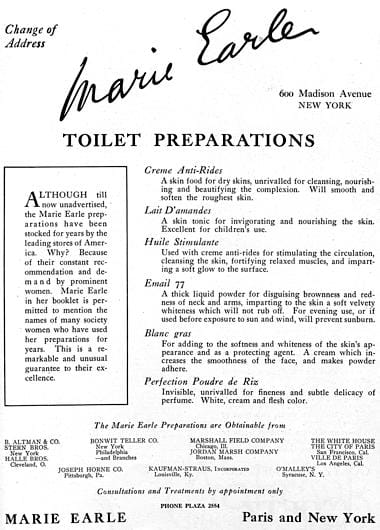
1919 Marie Earle at 600 Madison Avenue.
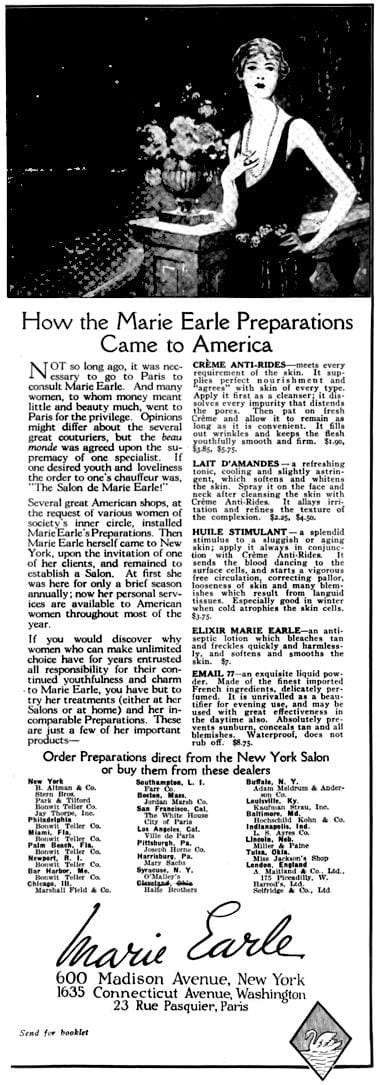
1922 How Marie Earle Preparations Came to America. The trademarked Marie Earle signature on the bottom of this advertisement was penned by Juanita Ebbsmith.
1922 Marie Earle at 23 Rue Pasquier, Paris.
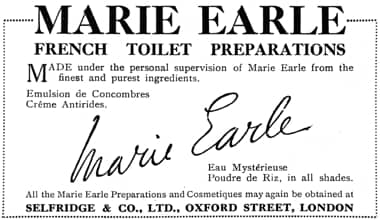
1922 Marie Earle (Britain). As well as Selfridges its products were also available at A. Maitland in Piccadilly and Harrods.
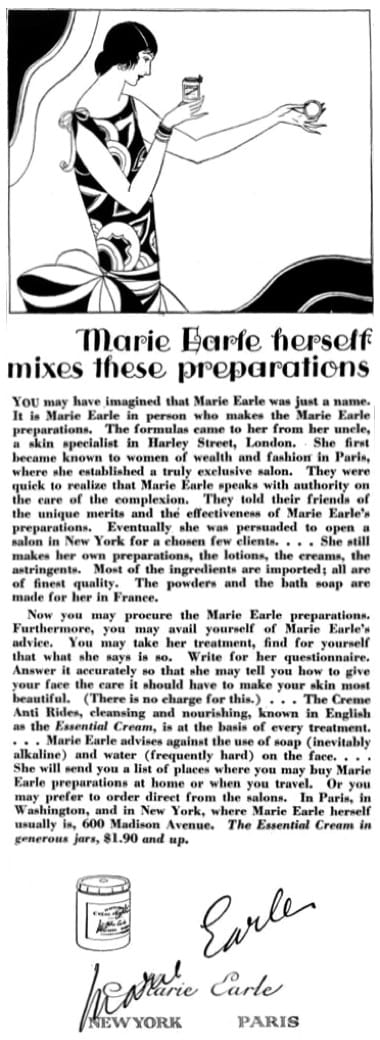
1924 Marie Earle.
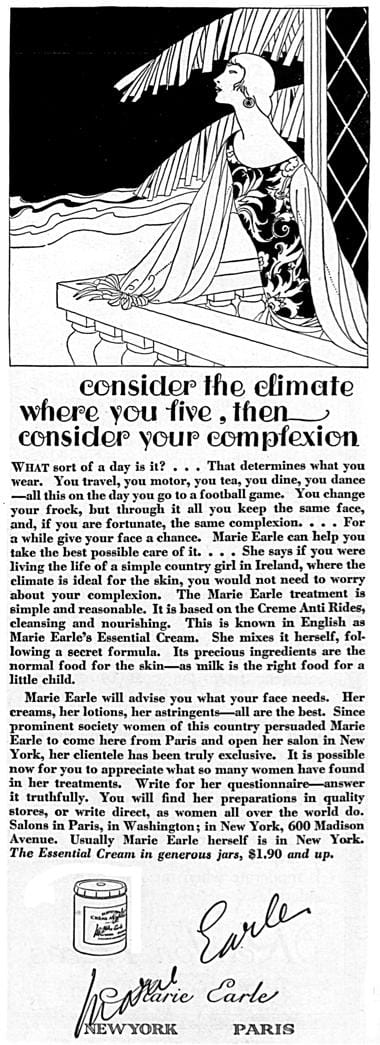
1924 Marie Earle.
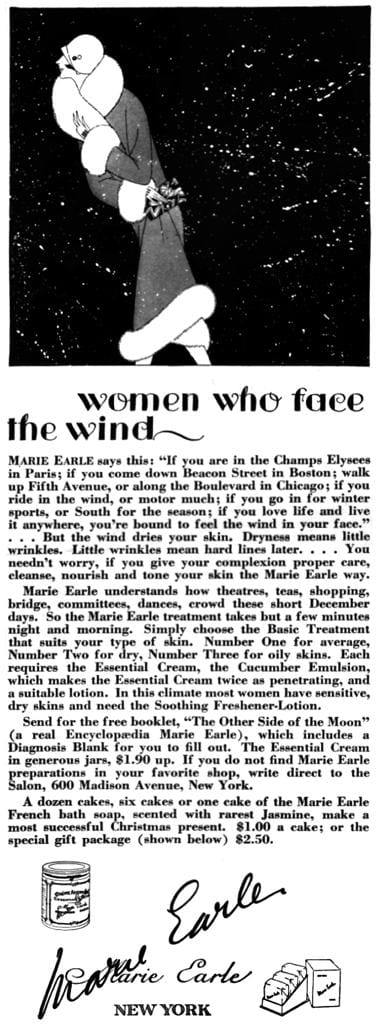
1925 Marie Earle.
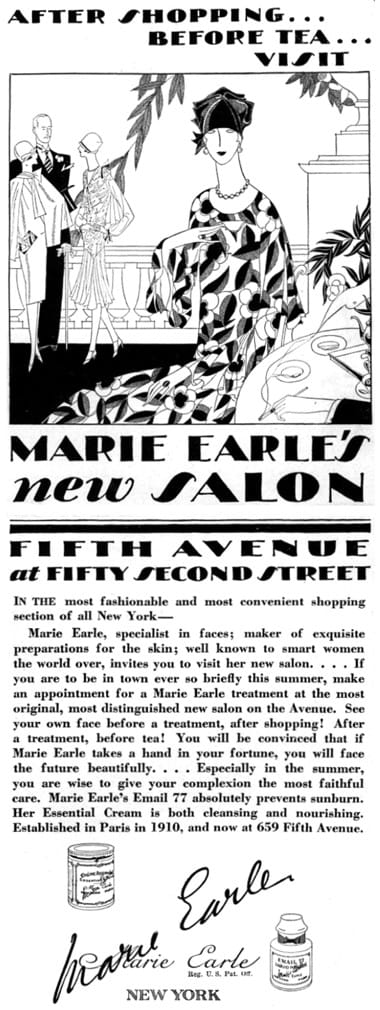
1926 Marie Earle salon at 659 Fifth Avenue, New York.
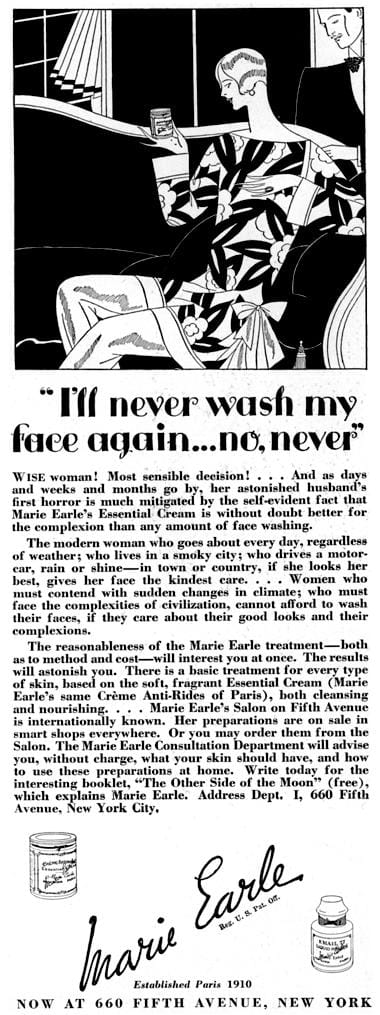
1927 Marie Earle.
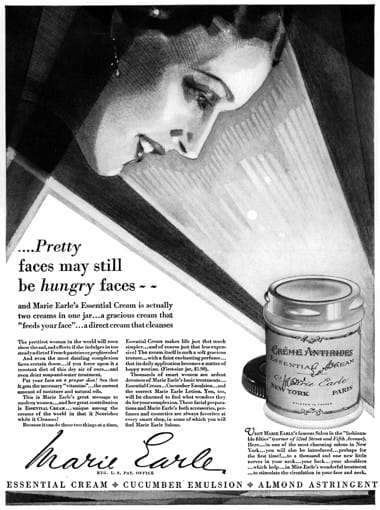
1928 Marie Earle Essential Cream.
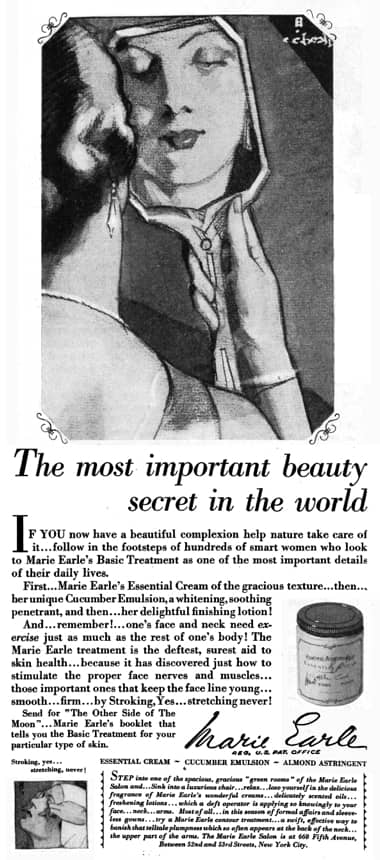
1928 Marie Earle Essential Cream.
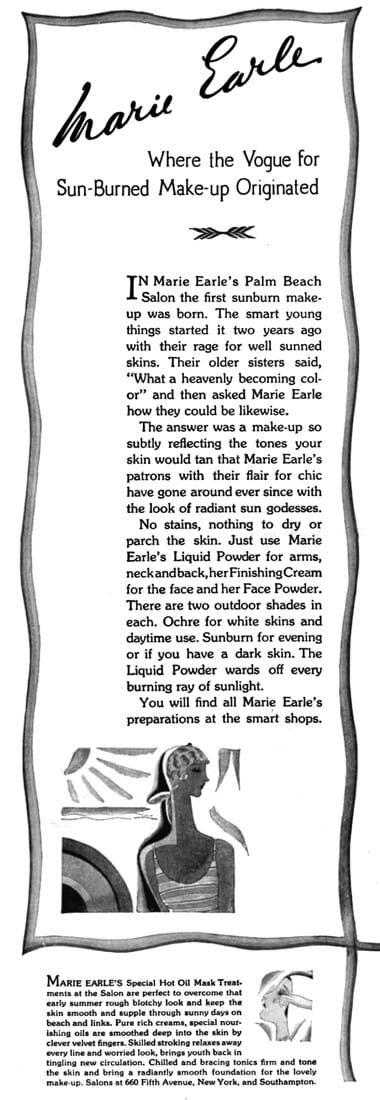
1929 Marie Earle Sun-burned Make-up and Hot Oil Mask Treatment.
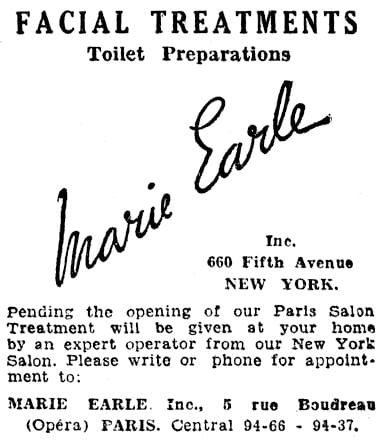
1929 Marie Earle (Paris).