
Beauty Milks
Most commercial skin-care cosmetics sold in the early twentieth century were creams with cold creams and vanishing creams being important examples.
See also: Cold Creams and Vanishing Creams
Liquid skin-care cosmetics were available but, as they were more liable to separate than the more viscous creams, manufacturers generally avoided making them. Like liquid face powders, these creams often had directions to ‘shake before use’ on their labels to ensure that their component parts were remixed before use.
See also: Liquid Face Powders
There was no standard nomenclature for liquid skin-care lines and they were given a variety of names. In English, these included milks, lotions, and liquid creams. The term milk was more common in Britain and Europe with lotion being preferred in America. Milks, known as beauty milks, complexion milks, and toilet milks, or laits in French, took their name from their milky appearance. Milk suggested purity and perhaps invoked the commonly held belief that ancient beauties, like Cleopatra, benefited from bathing in it.
Benzoin milks
One of the oldest beauty milks was Lait Virginal (Virgin Milk) had been around for centuries. It was a fine, white, milky-looking suspension made by mixing tincture of benzoin in rose water. As well as adding a fragrance many women believed that rose water had beautifying properties.
Simple tincture of benzoin 2.5 Rose-water diluted to 100.0 (British Pharmaceutical Index, 1923)
A similar milky mixture could be produced when benzoin was added to bath water. Richard Hudnut sold his Concrete Tincture Benzoin precisely for this purpose, supposedly reproducing the milky bath of eighteenth-century beauties.
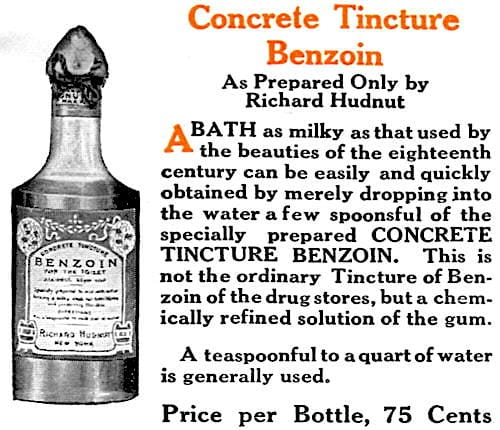
Above: 1910 Richard Hudnut Concrete Tincture Benzoin
Lait Virginal would separate over time so commercial versions increased its stability by adding glycerine and/or gum mucilages to increase the viscosity of the liquid.
Tincture of benzoin 25 oz. Glycerin 25 oz. Tragacanth mucilage 25 oz. Witch hazel solution 125 oz. Rosewater 800 oz. (Lee-Charlton, 1936, p. 62)
Emulsion milks
Improved beauty milks were produced by making them as emulsions. Like milk, these were white but tincture of benzoin could be added to increase their milky appearance. Early versions used powdered or flaked soap and borax and generally included the same mucilages used in benzoin milks to reduce the possibility of separation.
COMPLEXION MILK Soap, in flakes 1 oz. Water 3 oz. Heat and dissolve, then add
White wax ½ oz. Tincture of benzoin 2 dr. Spermaceti 1 oz. Cacao butter ½ oz. Continue the application of heat, with constant stirring, until a thick homogeneous emulsion is obtained, then slowly add a hot solution of
Water 10 oz. Glycerin and borax 2 oz. Set aside to cool, then incorporate
Mucilage of tragacanth 10 oz. Alcohol (90 per cent.) 2 oz. Santalol 1 dr. Oil of rose geranium 1½ dr. If too thick a little water may be added.
(The chemist and druggist, April 3, 1937, p. 412)
Two common beauty milks produced this way were Milk of Almonds and Milk of Roses, the later being a popular English formulation. These emulsion milks were dramatically different to the older benzoin milks and were also be referred to as lotions.
Milk of Almonds First quality white powdered soap 30 grams Spermaceti 30 grams White wax 30 grams Oil of almonds 500 grams Borax 30 grams Pour this base mixture into:—
Alcohol, 95 Per cent. 1 litre Distilled water 1 litre Glycerine 1 litre Essence of bitter almonds 12 grams (Durvelle, 1923, p. 262)
Milk of Roses (English) Spermaceti 30 grams White wax 30 grams Powdered soap 30 grams Melt the spermaceti, white wax and powdered soap into 560 grams of oil of sweet almonds then pour into:—
Rose water 11.5 c.c. Infusion of rose 1 litre Glycerine 1 litre Oil of French geranium 30 grams Salicylic acid 6 grams Phenyl ethyl alcohol 3 grams (Modified from Durvelle, 1923, p. 262)
In later versions the powdered or flaked soap was replaced with stearic acid and emulsifiers such as triethanolamine. This meant they had some similarity with vanishing creams so were also described as liquid creams.
BEAUTY MILK Avocado Oil 4.0 Tea seed oil 8.0 Stearic Acid 5.0 Triethanolamine 1.0 Mineral oil (viscosity 65/70) 8.0 Water 88.0 Perfume a sufficiency Apply with a small pledget of cotton, and allow it to remain on the skin for some time, preferably overnight.
(The chemist and druggist, April 3, 1937, p. 412)
Cetyl alcohol was often included as it acted as a subsidiary emulsifying agent and also gave the beauty milk a matt effect when it was applied to the skin (Lee-Charlton, 1936).
Lait de Toilette Stearic Acid 5.0 Beeswax 4.0 Cetyl alcohol 8.0 Glycerin 8.0 Triethanolamine 1.0 Witch hazel extract 88.0 Perfume q.s. (Modified from Lee-Charlton, 1936, p. 63)
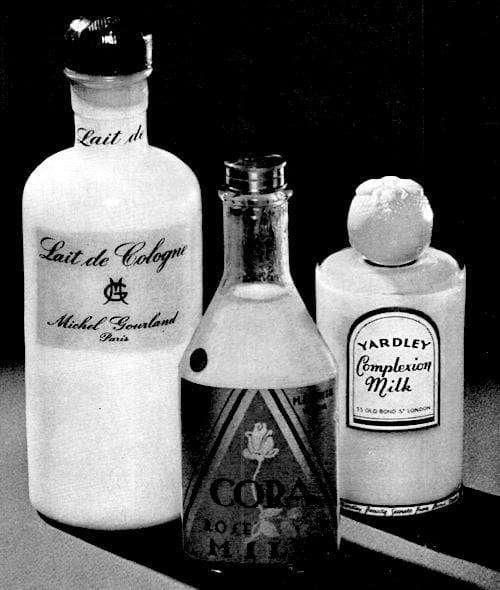
Above: 1936 Assorted Beauty Milks in varying opacities.
The stability of these beauty milks greatly improved with the development of better emulsifying agents and a greater use of homogenisers, a mechanical device that was also increasingly used on cow’s milk during the 1930s. Homogenisers broke up the droplets in the emulsion making them less likely to separate out. However, like creamy emulsions, manufacturers were advised to test new formulas to long periods of heat and cold to ensure that they remained stable over time.
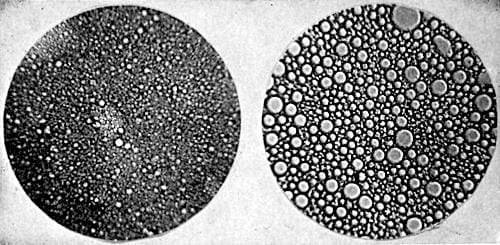
Above: Homogenised emulsion (left) and unhomogenised emulsion (right) (deNevarre, 1941, p. 195).
As products improved so did the popularity of liquid preparations which many women found easier to apply. As demand increased, manufacturers began to produce both liquid and cream versions of their skin-care lines a trend that continued to rise after the Second World War.
By this time, any distinction that might have been made between a beauty milk, a lotion, and a liquid cream had long since disappeared and the selection of a name simply became a company preference. As was the case earlier, British and European companies are more likely to refer to their liquid skin-care cosmetics as milks, Beiersdorf’s Nivea Milk being a good example.
First Posted: 13th September 2025
Sources
deNavarre, M. G. (1941). The chemistry and manufacture of cosmetics. Boston, MA: D. Van Nostrand Company, Inc.
Durvelle, J.-P. (1923). The preparation of perfumes and cosmetics. (E. J. Parry, Trans.). New York: D. Van Nostrand Company.
Gattefossé, R. M., & Jonquières, H. (1949). Technique of beauty products. (A.R.I.C., Trans.). London: Leonard Hill.
Kalish, J. (1935). Liquid Creams. The Drug and Cosmetic Industry. June, 38(6), 771-772, 784.
Lee-Charlton, H. (1936), Beauty Milks. The American Perfumer, July, 62-63, 97.
Marsek, F. A. (1920). Liquid creams and lotions. The American Perfumer and Essential Oil Review. June, XV(4), 127-128.
Thomssen, B. S. (1947). Modern cosmetics (3rd ed.). New York: Drug & Cosmetic Industry.
Toilet Milks. (1937). The Chemist and Druggist, July 24, 89.
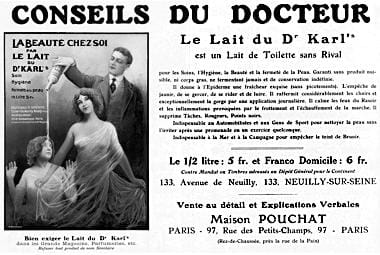
1911 Lait du Dr. Karl.
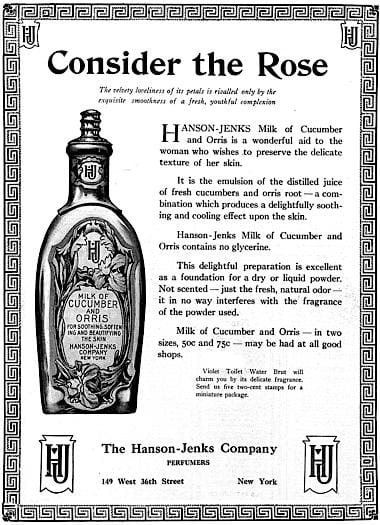
1912 Hanson-Jenks Milk of Cucumber and Orris.
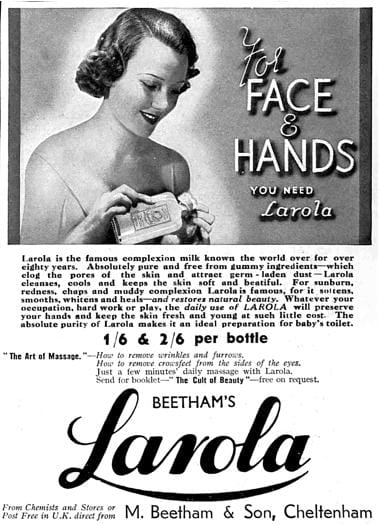
1926 Beetham’s Larola.
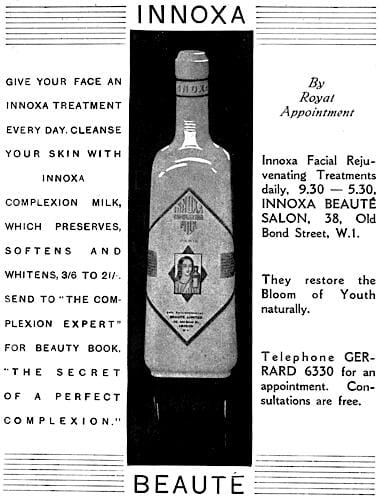
1930 Innoxa Complexion Milk.
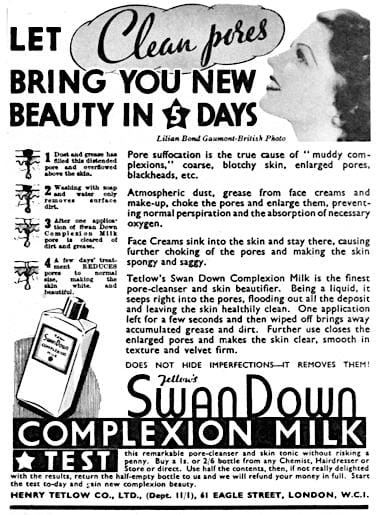
1936 Swan Down Complexion Milk.
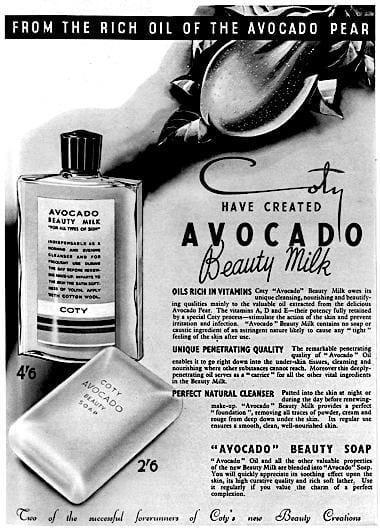
1936 Coty Avocado Beauty Milk.
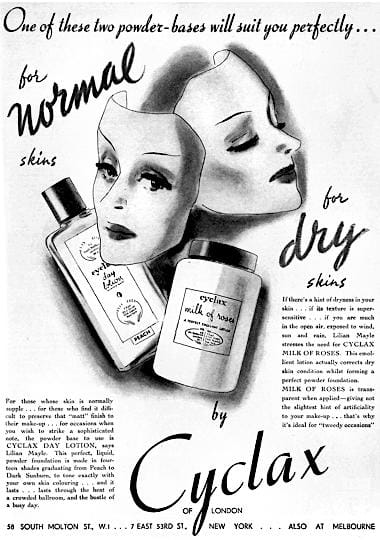
1938 Cyclax Day Lotion and Milk of Roses, the later cream being a good example of the arbitrary use of the term milk.
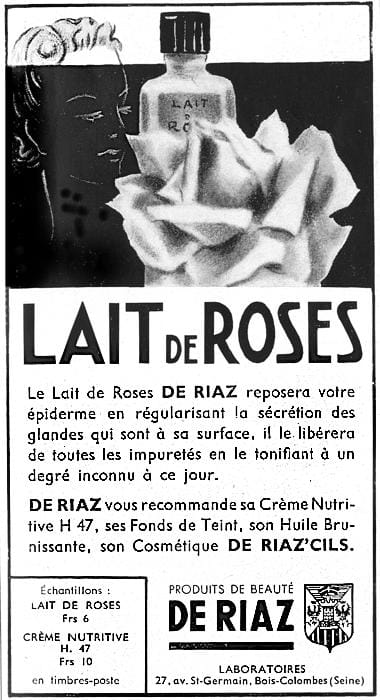
1939 Riaz Lait de Roses.
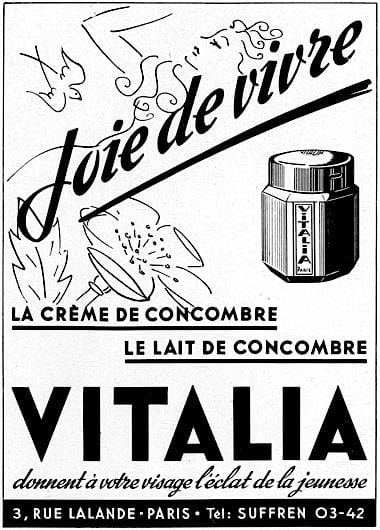
1946 Vitalia Crème de Concomber and Lait de Concombere, different versions of the same line.
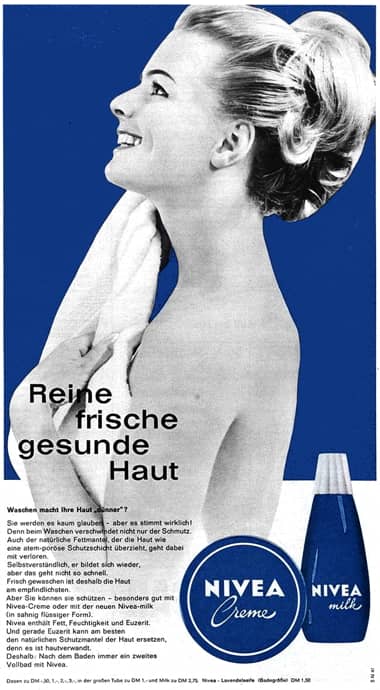
1964 Nivea Creme and Nivea Milk.