
Tho-Radia
Tho-Radia began with a single product – Crème Tho-Radia in 1933. Developed by the chemist, Alexis Jean Marie Moussalli [1894-1955], it was made by Secor (Société d’Exportation, Commission, Représentation) a company founded at 20 Rue Capucines, Paris in 1932. The name, Tho-Radia, was registered by Dr. Eugène Alfred Curie [b.1873] in 1932 (Lefebvre & Raynal, 2013, p. 20) and early advertisements suggested he was responsible for the formula which contained two radioactive compounds, thorium chloride and radium bromide. However, his role in the company, for which he was amply rewarded, was simply to suggest a connection with Marie Curie [1867-1934] and Pierre Curie [1859-1906], the discoverers of radium.
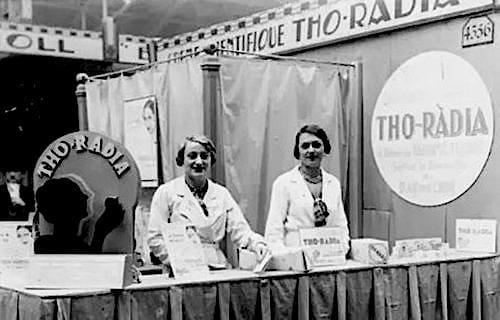
Above: c.1933 Tho-Radia stand at a trade show.
A number of advertisements used to launch Tho-Radia featured endorsements from actresses including Odette Florelle [1898-1974], Ginette Gaubert [1904-1987], Dolly Davis [1896-1962], and Alice Field [1903-1969]. These were soon replaced with a portrait of a blonde, lit from below to give her face a glowing look. The image was created by Antony (Tony) Charles Burnand [1892-1969], the director of Tony Burnand & Cie. It would become closely associated with Tho-Radia and be used by Secor for decades to come.

Above: 1933 Crème and Poudre Tho-Radia.
Crème Tho-Radia was quickly followed up with Poudre Tho-Radia (1933) in eight shades and Savon Tho-Radia (1934). The face powder was also advertised as containing thorium chloride and radium bromide, the soap with thorium chloride and balsam of Peru, the later ingredient presumably added for its healing properties.
Crème Tho-Radia: Made with radium and thorium. It stimulates cellular vitality, firms tissues, prevents enlarged pores, eliminates fat, prevents and heals scabs, pimples, and redness, preserves the freshness of the complexion, and prevents and removes wrinkles.
Poudre Tho-Radia: Made with radium, thorium and titanium. Continues and completes the action of the Tho-Radia cream. Perfectly thin, adherent and matte, it defends the skin against dust, miasmas, bad weather, harmful radiation. Increases the radiance of the complexion. Shades: Blanche, Naturelle, Rachel 1, Rachel 2, Ocre, Ocre Rosé, and Mauresque with Rose Clair (1935), Tahiti (1937), and Pêche (1939) added later.
Savon Tho-Radia: Made with thorium and balm of Peru. With its purity, softness and hygienic qualities, it protects the skin and gets it ready for Tho-Radia cream and powder.
As these products were radioactive they were only sold through pharmacies.
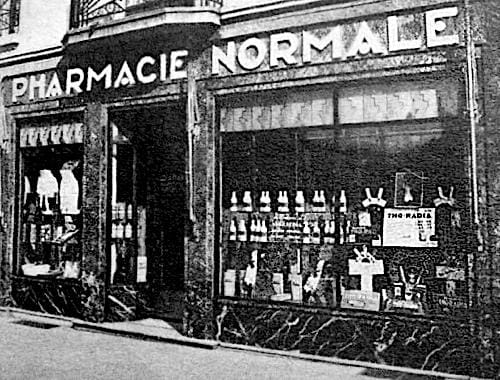
Above: 1935 Pharmacie Normal with Tho-Radia window display.
By 1934, sales were such that Secor decided it needed larger premises and moved from the Rue Capucines into a building it had acquired at 147 Avenue Victor-Hugo, Paris. The company had bought the rights to the Tho-Radia brand from Dr. Alfred Curie in 1933 in an arrangement that saw Curie receive, like Alexis Moussalli, a percentage of ongoing sales.
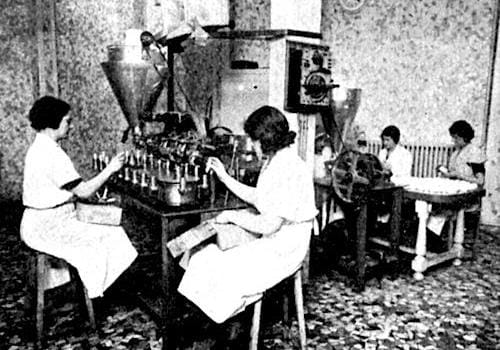
Above: c.1935 Manufacturing tubes of Crème Tho-Radia at 147 Avenue Victor-Hugo.
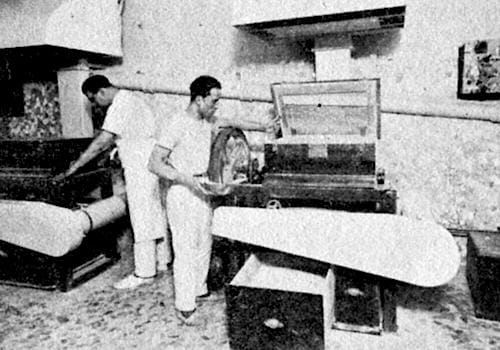
Above: c.1935 Making Poudre Tho-Radia at 147 Avenue Victor-Hugo.
Secor also began expanded its operations outside of France and was soon selling Tho-Radia in a number of other European countries. This did not appear to have included Britain and although a Tho-Radia Corporation was founded in New York in 1935, supposedly to establish Tho-Radia in the lucrative American market, it came to nothing. There could be lots of reasons why the American company failed to get off the ground but, as well as the adverse economic conditions, Congress was in the middle of developing legislation to regulate cosmetics which resulted in the 1938 Wheeler-Lea Act and the Food Drug and Cosmetic Act. This may have scared off potential investors.
See also: The FDA, FTC and Cosmetics
The Radior company, a British radium brand, met with a similar fate when they tried to enter the American market. In their case it appears that their failure was due to Americans being unconvinced that an expensive substance like radium could be included in a skin cream.
See also: Radioactive Cosmetics
In 1935, Secor added a number of additional lines to the Tho-Radia brand including Dentrifice Tho-Radia; Cold Cream Tho-Radia; Lait Démaquilleur Tho-Radia, and Crème Tho-Radia Mauresque. Cold Cream Tho-Radia was suggested as a night cream but could also be used during the day by women with dry skin. As its name suggests, Lait Démaquilleur was a liquid cleanser. Like Savon Tho-Radia it also contained balsam of Peru so had some healing properties. Crème Tho-Radia Mauresque was claimed to act as a sun protectant but as it was a dark shade it also provided the wearer with the appearance of a natural tan and could also be used as a coloured foundation (fond de teint). To complete the effect women could also use the Tahiti shade of face powder with arrived in 1937.
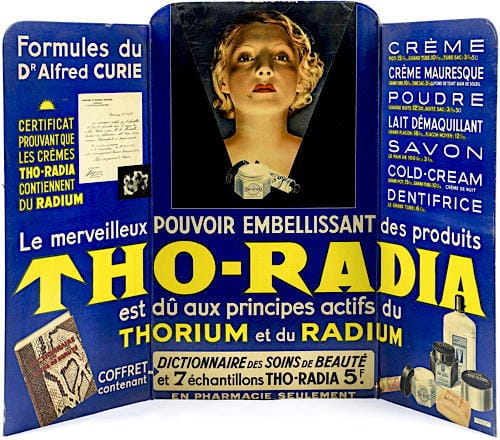
Above: c.1935 Display stand for Tho-Radia.
Dentrifice Tho-Radia: Astringent and bactericidal. Prevents and fights gingivitis and pyorrhea by destroying the microbial and spirillary flora, which cause mouth infections and conditions, as they develop.
Cold Cream Tho-Radia: [B]ased on Thorium, specially designed for nighttime rest for normal skin and daytime and nighttime care for very dry skin.
Lait Démaquilleur Tho-Radia: Made with Peruvian balsam, ensuring perfect removal of makeup and complete cleansing of the epidermis.
Crème Tho-Radia Mauresque: Specially designed not only to give the appearance of a natural tan and to protect the skin.
See also: Dictionnaire soins de beauté (c.1935)
In 1937, Tho-Radia added lipstick to its range in five shades.
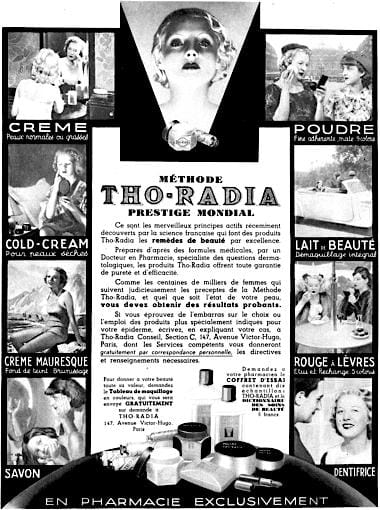
Above: 1937 Méthode Tho-Radia.
Rouge à Lèvres Tho-Radia: [H]olds perfectly without drying out the lips. Protects against cracks. Shades: Orangé, Feu, Vif, Moyen, and Foncé.
As far as I can tell the lipsticks did not contain any radioactive materials and soon after they were introduced this also applied to other Tho-Radia products.
Regulation
Towards the end of 1937, the French government published new regulations that classified radium and thorium as poisons. This meant that products containing either of these ingredients could only be dispensed with a doctor’s prescription and had to have an orange poison label added to the product. This forced Secor into removing radium and thorium from their cosmetics so any Tho-Radia products made from 1938 were no longer radioactive.
In 1938, Tho-Radia added a couple on new skin-care lines to its inventory. Lotion Faciale Astringente was said to prevent and cure wrinkles while Baume Solaire Tho-Radia was developed as a sun protectant. Tho-Radia also began marketing its skin-care cosmetics more conventionally, using functional terms for its creams such as Crème de Jour and Crème de Nuit.
Lotion Faciale Astringente: Prevents the formation of wrinkles and erases then in a short time.
Baume Solaire Tho-Radia: A creamy liquid that filters harmful rays with an efficiency that no other tanning oil reaches.
The first new make-up additions added after 1937 were a cream and compact rouge (fard gras and fard poudre) which came in the same five shades as the Tho-Radia lipstick introduced the previous year.
The addition of rouge enabled Tho-Radia to create a basic make-up plan. This began by cleansing the skin with Savon Tho-Radia, Lait Démaquilleur Tho-Radia if the skin was sensitive, or Cold-Cream Tho-Radia if it was dry. If wrinkles were a problem, cleansing could be followed with Lotion Faciale Astringente. For foundation (fond de teint), Tho-Radia suggested Crème Tho-Radia or Cold-Cream Tho-Radia if the skin was dry. Both creams could be mixed with Crème Tho-Radia Mauresque if a darker complexion was required. Rouge, lipstick and powder was then applied to complete the make-up routine with Tho-Radia suggesting that face powder be coordinated according to hair colour – Brown hair: Mauresque or Ocre; Chestnut hair: Ocre or Ocre Rosé; Redheads: Rachel 1 or Rachel 2; Blondes: Rachel 1 or Rose Vif; Grey or White hair: Naturelle.
War
When war broke out in September, 1939, Secor moved some of its activities to 46 Rue de Venise, Vichy as a precaution. The building backs onto the Schion river and is still there today. A second, larger building which was later secured at 25 Avenue de Lyon, Vichy also still stands (Lefebvre & Raynal, 2013, p. 128) and when the Germans occupied Paris, Secor moved all of its operations to Vichy and closed its Paris office in the Avenue Victor-Hugo.
Vichy was a luxury spa and resort town and it became the capital of Vichy France following the armistice with Germany in 1940. The Germans pressured the Vichy government to ’Aryanising’ Secor along with other French firms but fortunately its two Jewish shareholders, Alfred Mulvidson and his brother Alexandre, were living in Switzerland and the Swiss government intervened to prevented the sale of their shares (Lefebvre & Raynal).
Post-war
Following the liberation of Paris in 1944, Secor moved its offices back to the Avenue Victor Hugo but opted to keep most of its manufacturing in Vichy. Secor endeavoured to relaunch the Tho-Radia brand by advertising on the radio again and also engaging Jacqueline Donny [1927-2021], Miss France (1947) and Miss Europe (1948), to promote the brand.
The move towards normalising its skin-care range continued with the promotion of three Tho-Radia skin creams – Crème Tho-Radia, Crème Grasse, and Crème Nourrissante in jars and tubes. Crème Tho-Radia was replaced by, or renamed as, Crème de Jour in 1949.
Crème de Jour: The essential basis for good make-up for normal or slightly oily skin.
Crème Grasse: Specifically for the care of very dry skin.
Crème Nourrissante: Ideal as a night cream for all skin types. Recommended as a day cream for dry skin types.
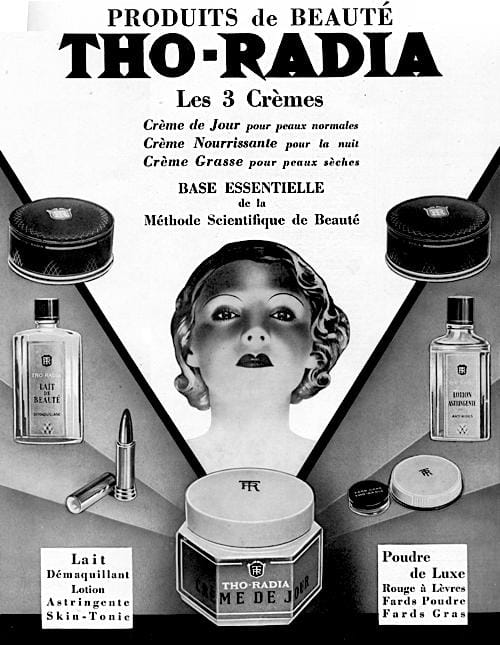
Above: 1949 Tho-Radia produits de beauté.
Other skin-care cosmetics added at this time included: Skin Tonic Tho-Radia (1948), a skin freshener; Crème au Citron de Tho-Radia (1949), a lemon hand cream; and Crème No. 6 (1951), an astringent cream that was credited with a very broad range of uses. Skin Tonic Tho-Radia and Crème No. 6 may have replaced the older Lotion Astringente.
Skin-Tonic Tho-Radia: Specially created to refresh and tone the skin and control perspiration.
Crème au Citron de Tho-Radia: Will keep your hands soft and white.
Crème No. 6: Used for all massages intended to prevent and fight wrinkles, crow’s feet, sagging chin, neck and bust, cellulite, as well as for slimming massages.
Tho-Radia added four new make-up items after the war. A new creamy foundation (fond de teint) in seven shades, Poudre de Luxe face powder in twelve shades, Rouge à Lèvre Colloidal 1301, a semi-automatic, refillable lipstick in twelve shades, and a crayon pour les yeux (eye pencil) in Noir, Brun, and Bleu shades.
Rouge à Lèvre Colloidal 1301: Meets the desires of women who, rightly, are particularly demanding in their choice of their lipstick. Shades: Pastel, Vif, Framboise, Moyen, Azalée, Foncé, Cyclamen, Camélia, Pivoine, Anémone, Cerise, and Fuschia.
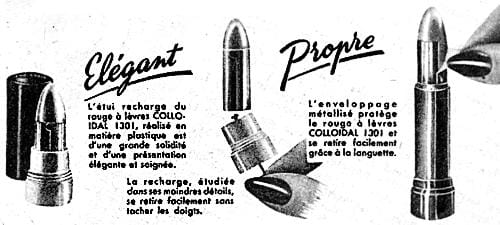
Above: 1952 Refill for the Colloïdal 1301 lipstick.
Tho-Radia offered some advice for selecting its foundations using hair colour as a guide, something it had previously done when recommending its face powders – Blondes: Rose de Mai, or Banane; Chestnuts: Ocre or Ocré Rose; Browns: Ocre or Mauresque. Two of the shades were for special purposes – Vert Nil was a green shade to tone down redness; Perveche was for evening use under artificial light.
Creme Fond de Teint Tho-Radia: To completely cover the face with a thin plain film. Shades: Rose de Mai, Vert Nil, Perveche, Banane, Ocre Rosé, Ocre, and Mauresque.
Poudre de Luxe Tho-Radia: Exactly the effect you are looking for. Extra-fine and matte gives the face an indefinable charm. Known shades: Blanche, Naturelle, Rachel 1, Rachel 2, Ocre, Ocre Rosé 2, Ocre Rosé, Ocre d’Or, Mauresque, Rose Clair, Tahiti, Pêche, Andalou, and Abricot.
The new lipstick shades introduced with Rouge à Lèvre Colloidal 1301 were matched with additional shades of cream and powder rouges (Fard Gras and Fard Poudre) with the Fard Poudre also given the De luxe treatment.
Other new products added after the war included: Tho-Radia Brilliantine (1948) a vitamin-rich brilliantine in two shades – Azur for brunettes, and Or for blondes; Eau de Cologne 80° (1949); and two perfumes (1950), Cabale and Coup de Grâce which were also used to scent face powders.
End of the line
Already under pressure, the brand which went into serious decline after the death of Alexis Moussalli in 1955. Secor decided to sell and it found a buyer in Lafarge Laboratories in 1962. Lafarge moved the Tho-Radia factory in Vichy to Châteauroux in 1965 but had closed the brand down by the end of the decade (Lefebvre & Raynal).
Timeline
| 1933 | Secor begins making Tho-Radia cosmetics at 20 Rue Capucines, Paris. New Products: Crème Tho-Radia; and Poudre Tho-Radia. |
| 1934 | Secor moves to 147 Avenue Victor-Hugo, Paris. |
| 1934 | New Products: Savon Tho-Radia. |
| 1935 | Tho-Radia Corporation founded in New York. New Products: Dentrifice Tho-Radia; Cold Cream Tho-Radia; Lait Démaquilleur Tho-Radia; and Crème Tho-Radia Mauresque. |
| 1937 | New Products: Rouge à Lèvres Tho-Radia. |
| 1938 | New Products: Lotion Faciale Astringente; Baume Solaire; Fards Gras Tho-Radia; and Fards Poudre Tho-Radia. |
| 1939 | Secor begins moving Tho-Radia manufacturing to Vichy, France. |
| 1944 | Secor moved its offices back to the Avenue Victor Hugo, Paris. |
| 1948 | New Products: Skin Tonic Tho-Radia; and Brilliantine Scientifique. |
| 1949 | New Products: Crème au Citron de Tho-Radia, Poudre de Luxe Tho-Radia, and Eau de Cologne. |
| 1950 | New Products: Crème Fond de Teint Tho-Radia; Rouge à Lèvres Colloïdal 1301; and Cabale and Coup de Grâce parfums. |
| 1951 | New Products: Tho-Radia Crème No. 6. |
| 1962 | Tho-Radia sold to Lafarge Laboratories. |
| 1965 | Vichy factory moved to 62 Rue de la Brauderie, Châteauroux. |
First Posted: 28th May 2025
Last Update: 10th February 2026
Sources
The American Perfumer & Essential Oil Review. (1906-1955). New York: Robbins Perfumer Co. [etc.].
Lefebvre, T. & Raynal, C. (2013). Les métamorphoses de Tho-Radia: Paris-Vichy. Paris: Éditions Glyphe.
Tho-Radia. (c.1935). Dictionnaire medical et pratique de soins de beauté [Booklet]. Paris: Author.
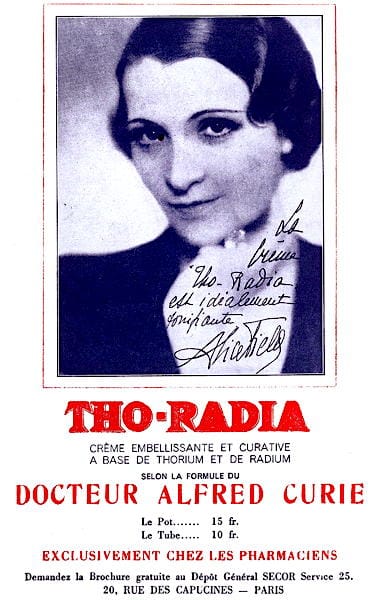
1933 Tho-Radia endorsed by the French Algerian actress Alice Field [1903-1969].
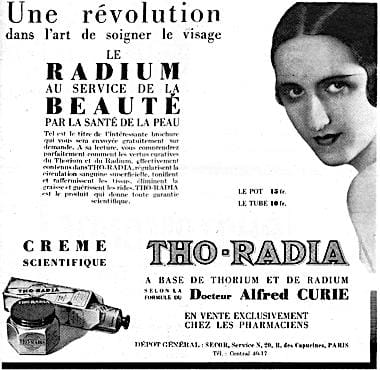
1933 Crème Tho-Radia.
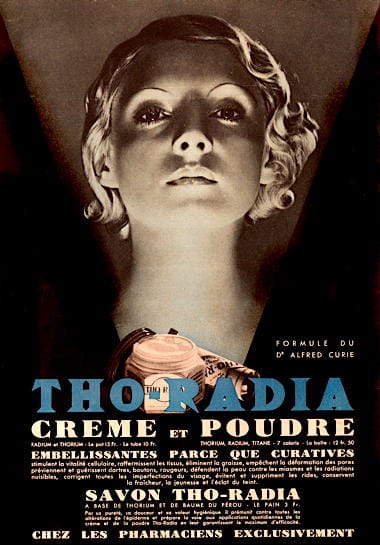
1934 Crème, Poudre, and Savon Tho-Radia.
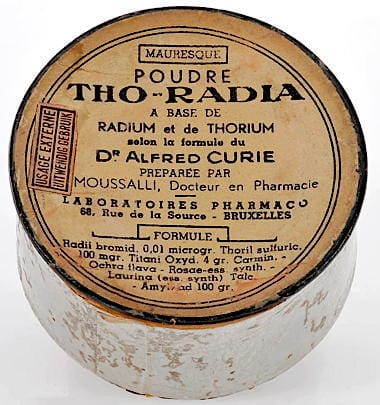
Poudre Tho-Radia (Switzerland).
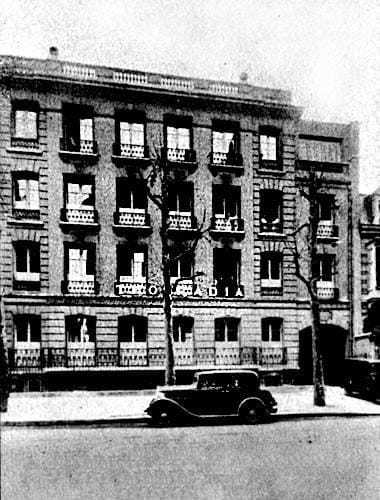
1935 Tho-Radia at 147 Avenue Victor-Hugo, Paris.
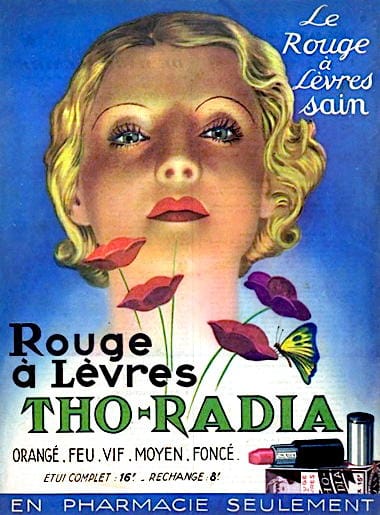
1937 Rouge à Lèvres Tho-Radia.
1937 Méthode Tho-Radia.
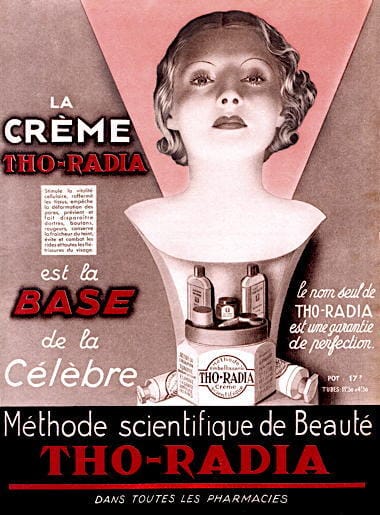
1938 Tho-Radia with no mention of thorium or radium.
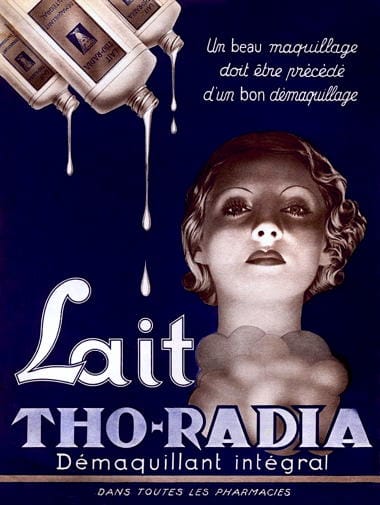
1938 Lait Démaquillant.
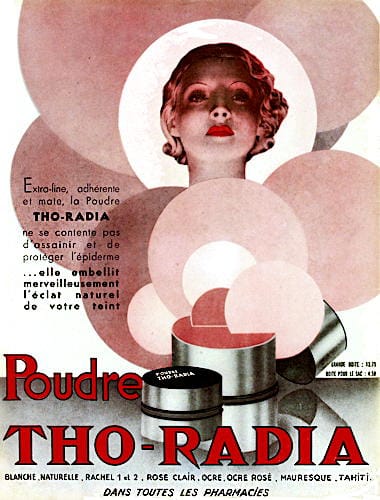
1938 Poudre Tho-Radia.
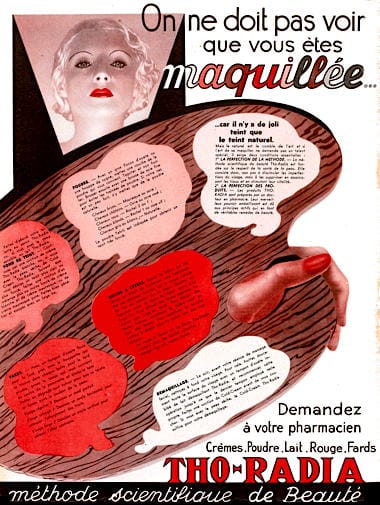
1938 Maquillage Tho-Radia.
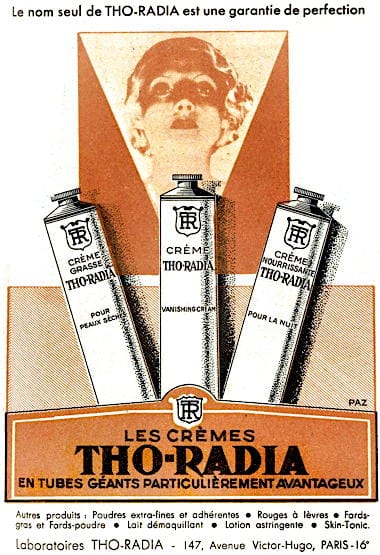
1948 Crème Tho-Radia, Crème Grasse, and Crème Nourrissante.
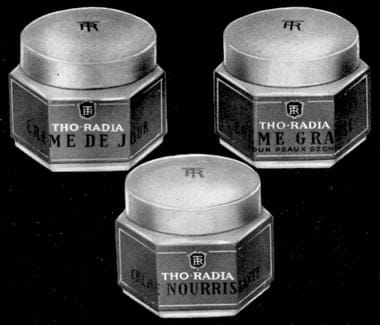
Above: 1949 Crème de Jour, Crème Grasse, and Crème Nourrissante.
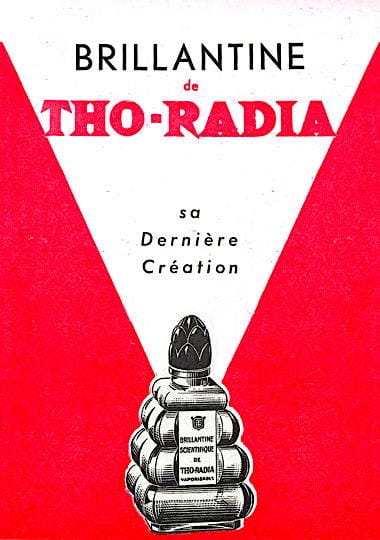
1948 Tho-Radia Brilliantine.
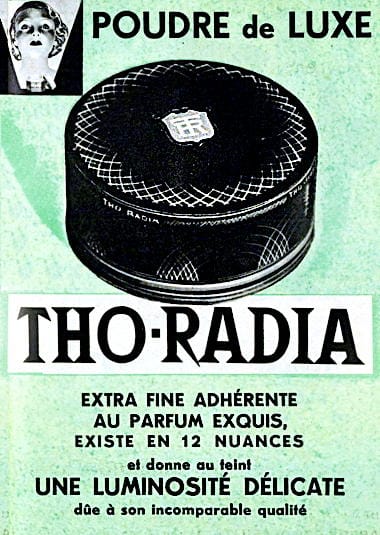
1949 Poudre de Luxe Tho-Radia.
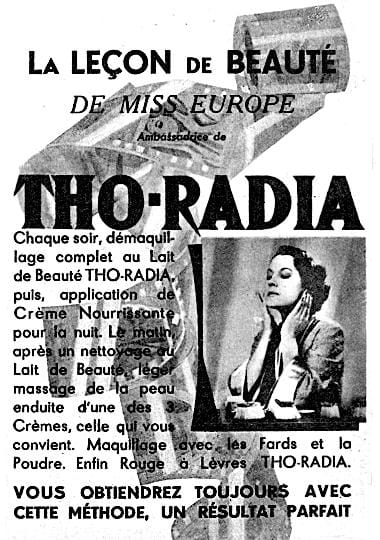
1949 Jacqueline Donny promoting Tho-Radia.
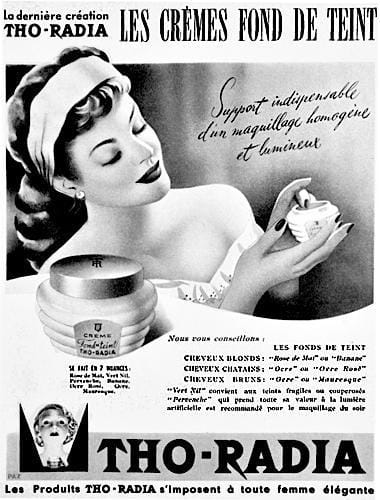
1950 Créme Fond de Teint.
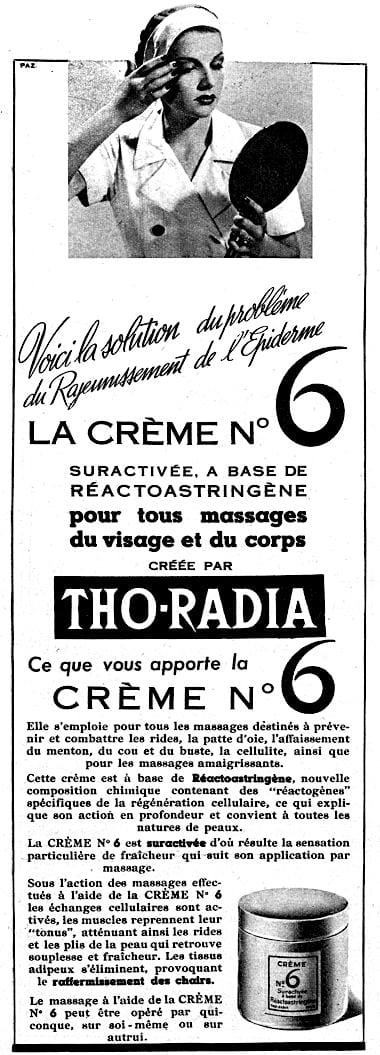
1951 Tho-Radia Crème No. 6.
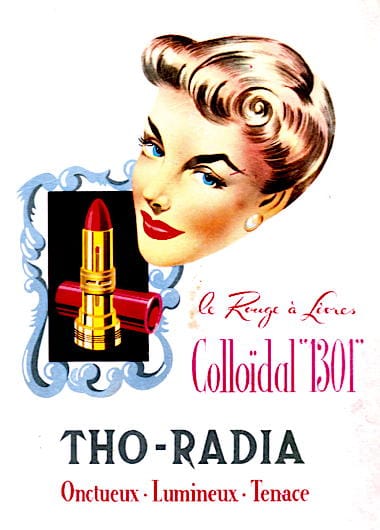
1951 Rouge à Lèvres Colloïdal 1301.
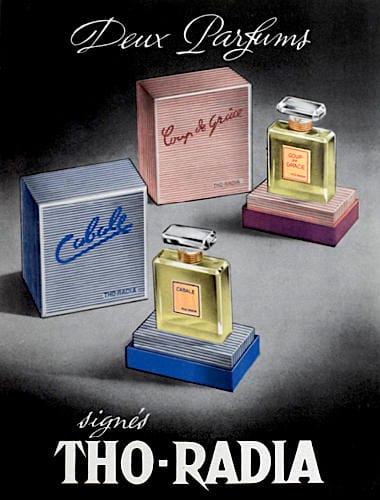
1951 Tho-Radia Coupe de Grâce, and Cabale parfums.