
Rouge Baiser
Le Rouge Baiser was an indelible lipstick introduced by Paul Baudecroux in France in 1927. Its formulation differed from other indelibles of its time and it went on to become the best selling lipstick in France with some suggesting that it accounted for up to 50% of lipstick sales there for a time.
Very little is known about Paul Baudecroux’s early life. He was born into a well-to-do family in Cusset, France and grew up there. After graduating from school he was apprenticed to photography studio in Vichy later moving to Paris and opening his own portrait photography studio there at 7 Rue des Ternes. By 1924, he had moved the studio to the more fashionable address at 14 Rue du Faubourg Saint-Honoré.
Working as a photographer would have given Baudecroux some understanding of chemistry and his work as a portrait photographer might also explain his interest in cosmetics. His first venture in this field was a set of face creams which debuted in 1924. Crème Oxyneige came in three formulations, one each for Normal, Oily, and Dry skin types. The ‘oxygen’ in the creams may have been hydrogen peroxide, commonly used in face creams as a skin lightener. The creams were also advertised a made without glycerine which Baudecroux claimed could be irritating.
A 1925 article in ‘The Delmarvia Star’ in Wilmington, Delaware suggests that Baudecroux may have been experimenting with face creams for some time.
Paul Baudecroux, a French chemist, claims to have a chemistry of cosmetics that has never before existed.
“I have succeeded in transforming into white, perfumed creams, which are good adherents for powder all lubricants, greases and fruit juices employed in dermatology,” he said. “They are chemically pure and neutral.“
M. Baudecroux’s catalogue, just issued, contains 463 formulae and production is already in progress. No matter how difficult the skin—to touch or to entice—he has something to make it delicious. He has many olive oil creams, others of cocoa butter, table butter, paraffin, leaf lard, kid tallow, badger fat, castor oil, sweet almonds, whites of egg and honey.(The Delmarvia Star, April 5, 1925)
Baudecroux’s next venture was Le Rouge Baiser lipstick. Introduced in 1927, its formula was covered by a patent that Baudecroux filed in September 23, 1927 (FRA No. 557,609). He vigorously defended infringements on his patent and also took counterfeit lipsticks to court.
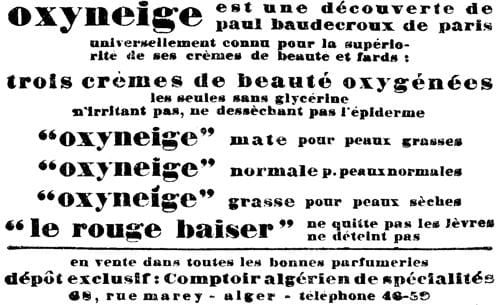
Above: 1927 Crème Oxyneige and Le Rouge Baiser.
Lipstick formulation
Like other indelibles, Rouge Baiser contained a dye to stain the lips. However, it used a water-soluble eosin rather than one of the water-insoluble eosins (bromo acids) found in most other indelibles. Unfortunately, I have no records of the exact form of eosin that was used. Some have suggested it was aniline but Baudecroux denied that this was the case.
To enable the water-soluble dye to be combined with the water-insoluble fats, oils, and waxes needed to make the stick, Baudecroux formulated the lipstick as an emulsion rather than as a mixture. To achieve this, he dissolved the eosin in a glycol, most probably propylene glycol, and then used an emulsifying agent like triethanolamine to disperse the dissolved pigment evenly through the other components of the lipstick. The Baudecroux patent provided examples on how to produce the emulsion, one of which was conveniently translated by an American trade journal.
Emulsions are used in place of straight mixtures. Thus mixture of 10 parts almond oil, ten parts lanolin, 100 parts spermaceti, one part neutral almond oil soap is melted at 50° to 60°C. Then, without allowing temperature to drop, 40 parts of an approximately 12 to 15% solution or suspension of fat-insoluble coloring matter in emulsifiable solvent are added. Mixture is agitated until emulsion is formed, which is poured into molds, and allowed to solidify.
(The Drug and Cosmetic Industry, 1932, p. 485)
Baudecroux may have used propylene glycol before in his Oxyneige creams. As noted previously, these creams were made without glycerine (also a glycol), and it is possible that Baudecroux used propylene glycol as a substitute.
By the 1930s, Baudecroux seems to have closed his studio to concentrate on manufacturing but kept the office at Faubourg Saint-Honoré going for administrative purposes. In 1930, he bought the Company Française des Comprimés, based at 45 Rue Ganneron, Paris, which had gone into receivership, and began manufacturing there. Production moved to 125 Boulevard Saint-Denis, Courbevoie when Baudecroux opened a factory there in 1937.
In 1930, Baudecroux added Dentrifice Vichy (1930), a tooth cleanser in paste and powder forms and followed this up with two other lines – Boul, a toothbrush; and Phlorethol, a nonflammable dry shampoo. Despite its name, Dentrifice Vichy was made with mineral salts not Vichy water and the Compagnie Fermière de l’Etablissement Thermal de Vichy took Baudecroux to court over the matter and Baudecroux was forced to cease production and pay a fine.
Cusset envied its close neighbour Vichy and had ambitions to become a spa town as well. Having grown up in Cusset, Baudecroux knew this and decided to make this long-standing desire a reality. In 1935, he became part owner of the mineral spring in Cusset, the Eau de la Source Andreau, acquired land around the town and made plans to open a health and beauty spa there. The local authorities were enthusiastic and some work was done but the project was derailed by the Second World War. Some remnants of the scheme can still be seen in Cusset, including the Parc Paul Baudecroux.
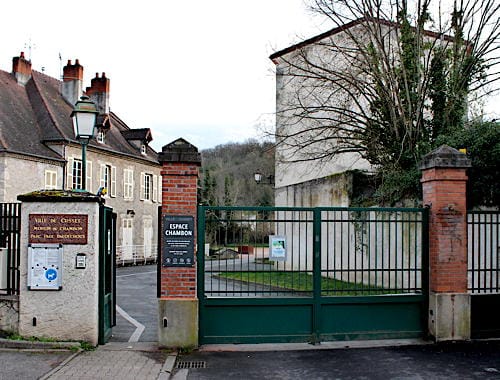
Above: North entrance to the Parc Paul Baudecroux.
Black Lipstick
Sales of Rouge Baiser grew in France and some European countries during the 1930s but the lipstick was not available in America or Britain. When Baudecroux did introduce a lipstick into the American market in 1938 it came in a radically different formula to the Rouge Baiser lipstick sold in France. Distributed by the Wonka Distributing Company, it used an oil-soluble dye to stain the lips rather than the water-soluble eosin used in the original Rouge Baiser lipstick. The black lipsticks were a very dark red, giving them an almost black colour but produced a red mark on the lips when applied.
Rouge Baiser: “[I]t’s black as jet but turns a luscious glowing red on your lips! Indelible, too!” Shades: Light, Medium, Dark, Claret, Orange, and Nasturtium.
I do not know why Baudecroux went with this black lipstick rather than the original Rouge Baiser but it seems likley that he had problems with regulatory authorities there. Aniline dyes had come under increased scrutiny in the United States after the Lash Lure scandal of 1933 and Baudecroux may have been unable to get approval to use his dye. Unfortunately, I have no documentation to support this.
see also: Lash Lure
I am also at a loss to explain why Rouge Baiser was not introduced into Britain.
Baudecroux did introduced a cosmetic called Noir Baiser (Black Kiss) in France in 1940 but it was a mascara, not a lipstick. It came in Noir, Blue, Blond, Vert, Améthyste, Brun, and Chatâin shades.
War
France was divided after its defeat by Germany in 1940 with Cusset becoming part of what was known as Pétainist France, a government headed by Marshal Philippe Pétain [1856-1951] that was based in Vichy.
Baudecroux decided to stay in Cusset and did not return to Paris until 1942, hiring Auguste Anselin [1912-1989] to manage the firm in his place. The company operated right through the war, even advertising in Parisian German language newspapers.
Post war
Baudecroux was arrested in 1947 accused of trading with the Third Reich, selling lipstick on the black market, and currency irregularities during the war. Baudecroux maintained his innocence and claimed that the irregularities were Anselin’s. Baudecroux was released but was given a two-year suspended sentence, had 250 million francs of illicit profits confiscated, and was fined 375 million later reduced to 180 million. The company was put in administration until the fine was paid with Anselin in charge.
Baudecroux’s problems with the Committee for the Confiscation of Illicit Profits had died down by the time he opened a new shop and showroom at 27 Rue du Faubourg Saint-Honoré in 1949.
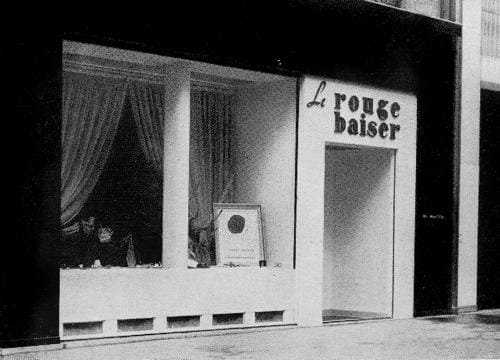
Above: 1951 Rouge Baiser shop at 27 Rue du Faubourg Saint-Honoré.
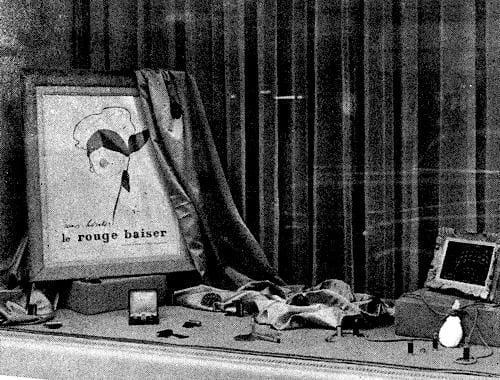
Above: 1952 Rouge Baiser shop window on the Rue du Faubourg Saint-Honoré.
Along with the shop, sales of Le Rouge Baiser received a major boost from a new advertising campaign which featured images created by the artist René Gruau [1909-2004], one of which has become almost synonymous with Rouge Baiser.
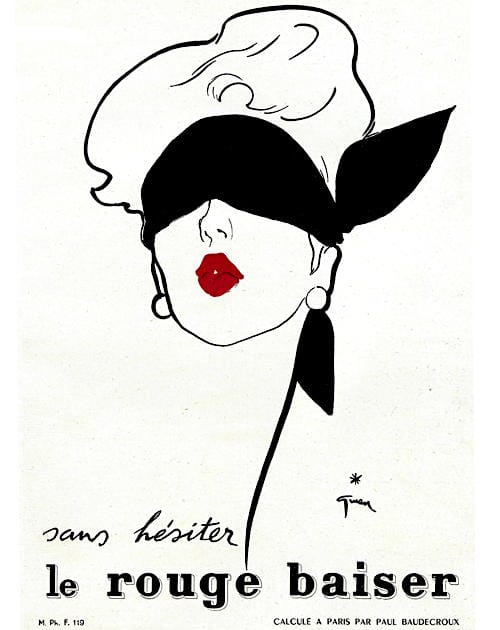
Above: 1949 Rouge Baiser by René Gruau.
Shade range
By 1949, when the shop opened, Le Rouge Baiser was being produced in 36 shades. There were 21 natural shades: Orange, Capucine, Clair, Moyen, Foncé, Grenat, Feu, Cyclamen, Vénitien, Vision, Amethyste, Bourgogne, Groseille, électric, Dahlia, Chaudron, Fraise, Aubergine, Violine, Muscat Rouge, and Chasselas Rosé, and 15 pastels shades: Rose Baiser, Vieux Rose, Géranium, Pois de Senteur, Saumon, Lilas, Myosotis, Azalée, Camélia, Pivoine, Érevisse, Mimosa, Primevère, Abricot, and Ananas.
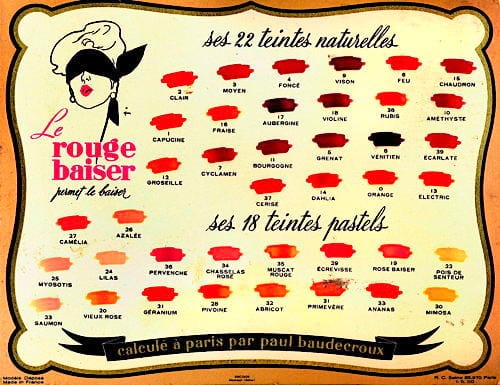
Above: c.1950 Rouge Baiser shade card.
The shade range had increased to 40 by the 1950s. Muscat Rouge, and Chasselas Rosé were reclassified as pastels and Cerise, Rubis, and Écarlate were added which brought the natural shade range up to 22. The Pastel range was also increased to 18 with the addition of Muscat Rouge, Chasselas Rosé, and Pervenche.
Lipstick Cases
Le Rouge Baiser came in a variety of case designs during the 1950s, – standard plastic, black and silver-tone, black and gold-tone, and automatic. Some of the cases came in large and small sizes that held either 9 mm or 11 mm lipsticks.
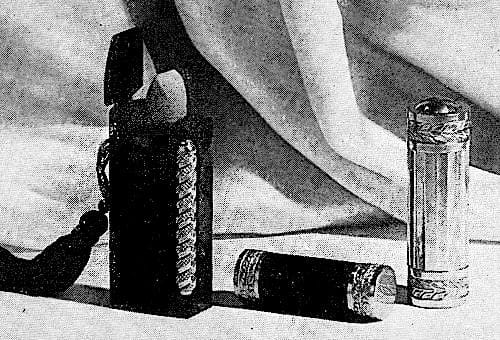
Above: 1952 Le Rouge Baiser lipsticks. Automatic (left), black and gold-tone (centre) and fully gold-tone (right) cases.
Baudecroux developed some of these case designs. A German patent (No. 815826) describes the design for a twist-up lipsticks with two shell-shaped flaps on the top of the lipstick that would open when the lipstick was extended and close when it was withdrawn back into the case.
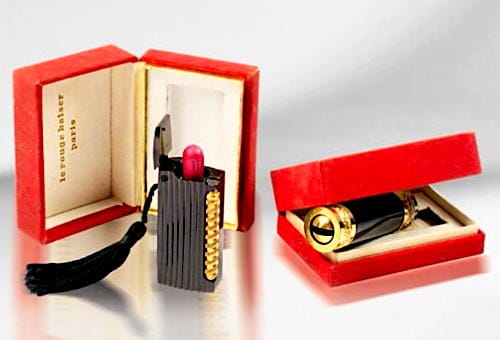
Above: Le Rouge Baiser lipsticks. The one on the left is a true automatic as it can be opened and closed with one hand. It was invented by Marcel Fouter (French Patent No. 936919, 1948). The lipstick on the right, invented by Paul Baudecroux, is partially opened so you can see the two shell-shaped flaps.
Users were advised to apply the lipstick gradually to build up its intensity which reached its peak about 20 minutes after the lipstick was first applied. The instructions were also careful to highlight the need to close the lipstick case carefully after use. This was important one of the problems with using water-soluble dyes in lipsticks was that the glycol was very susceptible to humidity. It tended to loose water when the humidity of the air was low and gain it when the humidity was high. This problem was highlighted by Maison G. deNavarre in 1941.
Although once popular, and to a certain extent sensible, the practical results at first were not all that was desired. It was impossible to prevent evaporation of the water. Surface bronzing readily developed due to the water soluble color used. The mass shrank and came loose from the holding cup. It would fall out of the holder, be broken off or otherwise damaged. It also presented a microbial problem.
(deNavarre, 1941, p. 827)
La guerre des batons de rouge
Baudecroux’s company had come out of administration in 1949 but the 1950s saw him involved in a new round of court cases which some French newspapers called the ‘La guerre des batons de rouge ’ (The war of the lipsticks).
The dispute was primarily between Paul Baudecroux and Auguste Anselin. Anselin had bought an ailing company that sold a lipstick called Tr`s Bien and Baudecroux accused Anselin of diverting raw materials and funds from the Courbevoie factory to Très Bien. Both men ended up being arrested with charges on Anselin’s side being associated with missing funds and beating up a witness to get documents, while Baudecroux was charged with attempting to bribe officials. Baudecroux was given an 18 month suspended sentence and a 4 million franc fine.
Toxic colourants
In addition to his problems with Anselin, Baudecroux was also being investigated for using toxic colourants which may suggests that he was using aniline after all. This would eventually result in formulation changes for Le Rouge Baiser, reducing its indelibility.
Later events
Baudecroux died in 1957 and this is where my interest in Rouge Baiser ends. By this time the demand for indelibles was waning with creamier lipsticks coming into vogue. Rouge Baiser was also having to complete with a number of well-funded American imports including Revlon which had opened a factory in France in 1951. Perhaps in response to this, Rouge Baiser began selling its lipsticks in two formulations in 1958 – Le Rouge Baiser Indéléble and Le Rouge Baiser Semi-Gras. To better complete with foreign lipsticks, Rouge Baiser introduced a nail polish in 1959 in shades to match its lipsticks, something that had become almost a necessity. Other lines followed and the company had a complete make-up range by the end of the 1960s.
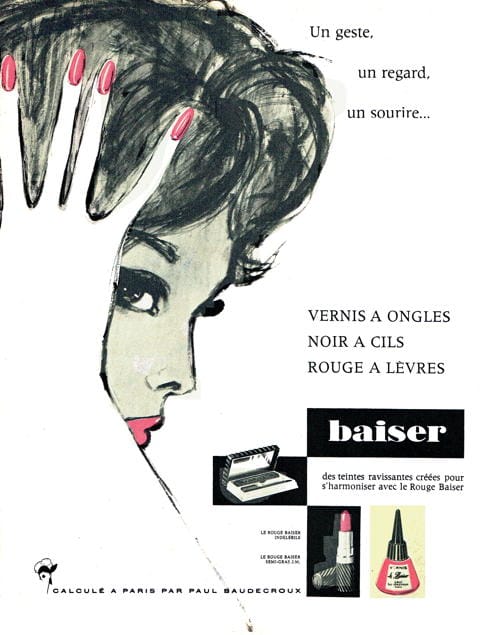
Above: 1960 Baiser Vernis à Ongles, Noir à Cils, and Rouge à L`vres.
Rouge Baiser is currently owed by the Sodalis Group who bought it from the Deborah Group in 2018. The Deborah Group had owned Rouge Baiser since 1994.
Timeline
| 1927 | New Products: Le Rouge Baiser. |
| 1930 | Company Française des Comprimés aquired. New Products: Dentifrice Vichy. |
| 1937 | Factory opened at 125 Boulevard Saint-Denis, Courbevoie. |
| 1949 | Store and showroom opened at 27 Rue du Faubourg Saint-Honoré. |
| 1958 | New Products: Le Rouge Baiser Semi-Gras. |
| 1959 | New Products: Le Baiser Vernis. |
| 1963 | Le Rouge Baiser lipstick imported into Britain by Warrick Brothers, Ltd. |
| 1994 | Deborah Group acquires Rouge Baiser. |
| 2018 | Deborah Group acquired by Sodalis Group. |
First Posted: 12th September 2026
Sources
Browning, E. H. (1898). Beauty Culture. London: Hutchinson & Co.
deNavarre, M. G. (1941). The chemistry and manufacture of cosmetics. Boston, MA: D. Van Nostrand Company, Inc.
The drug and cosmetic industry. (1932-1997). New York: Harcourt Brace Jovanovich [etc.].
Lipsticks stick with ’indelibles’. (1955). Chemical Week 76(15). 97-98.
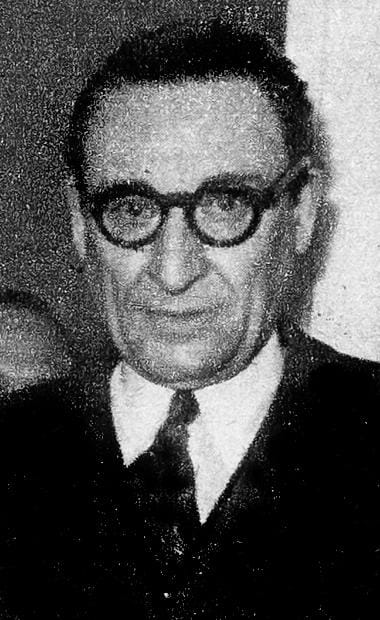
Paul Baudecroux [1892-1957]. This photograph was taken around 1949.
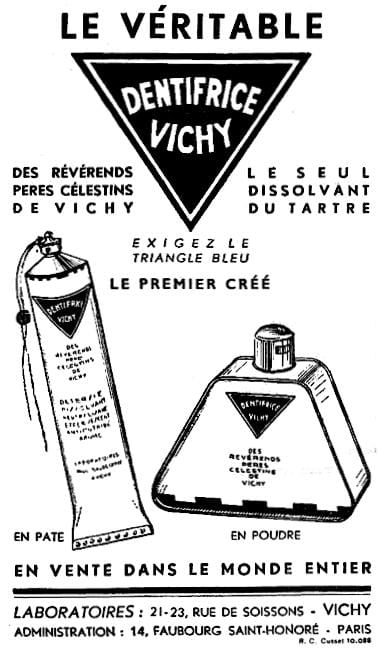
1937 Dentifrice Vichy.
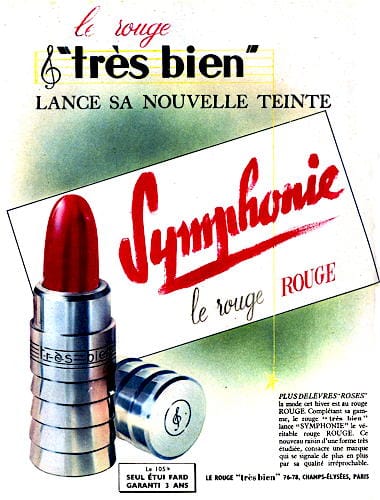
1947 Rouge Très Bien.
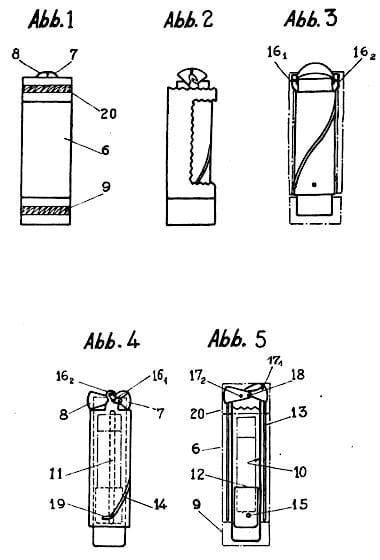
1948 Drawings from the Baudecroux patent with the shell-shaped flaps (German Patent No. 815826).
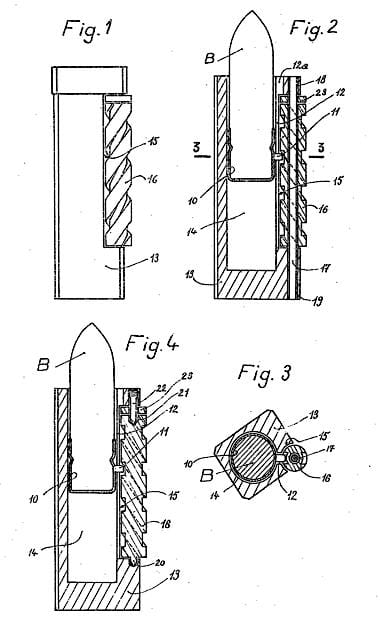
1948 Drawings from the Fouter patent for the automatic lipstick (French Patent No. 963919).
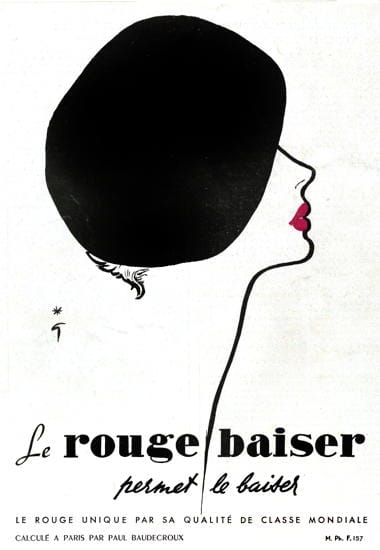
1949 Le Rouge Baiser.
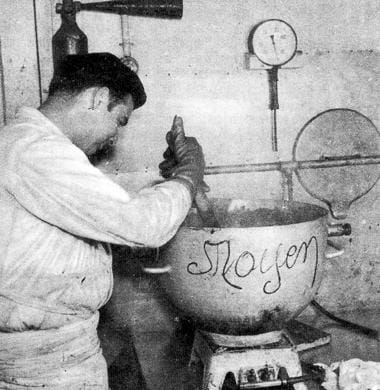
1951 Mixing lipstick in Courbevoie.
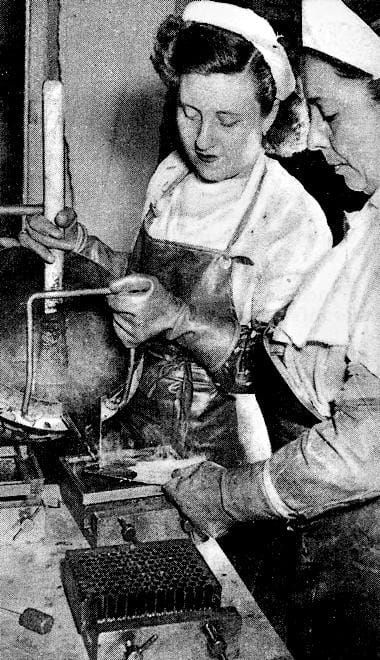
1951 Pouring lipstick into moulds in Courbevoie.
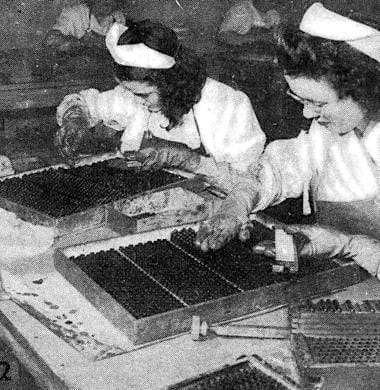
1951 Extracting lipsticks from their moulds and putting them into bakelite cases iin Courbevoie. The women are gloved to avoid staining their hands.
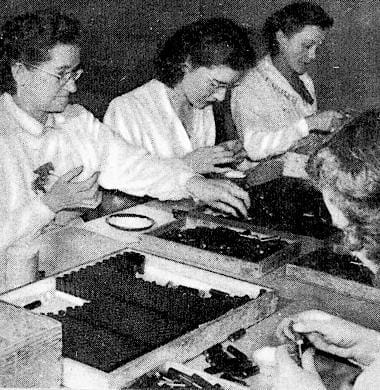
1951 Capping and labelling lipsticks in Courbevoie.
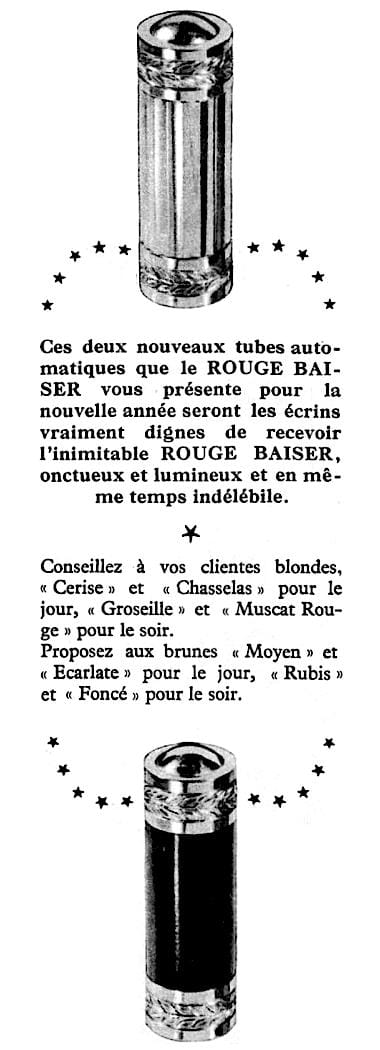
1951 Le Rouge Baiser cases. Both of these twist-up cases use the Baudecroux patent.
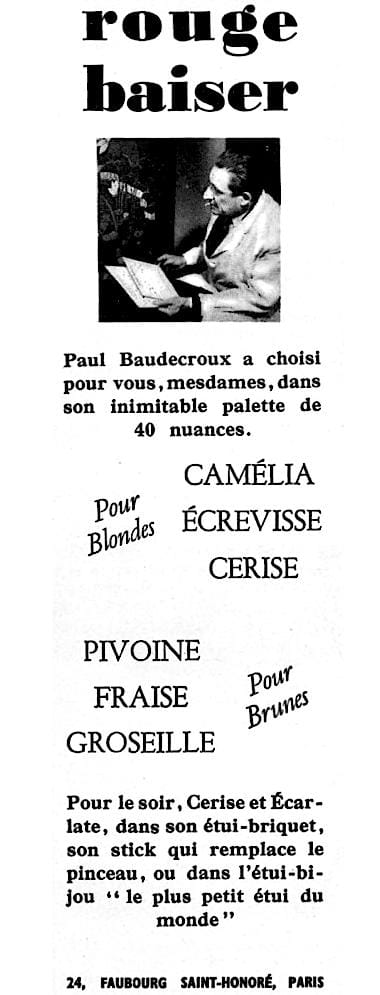
1951 Le Rouge Baiser. The man in the image is Paul Baudecroux. He is holding a number of shade charts.
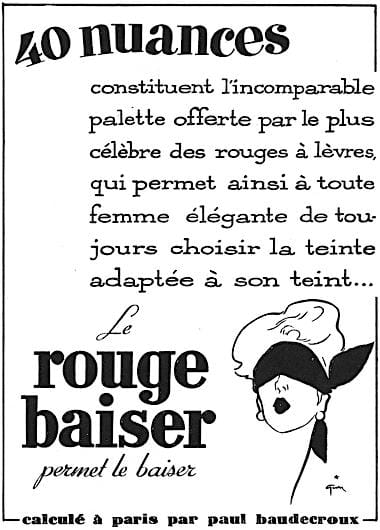
1953 Le Rouge Baiser.
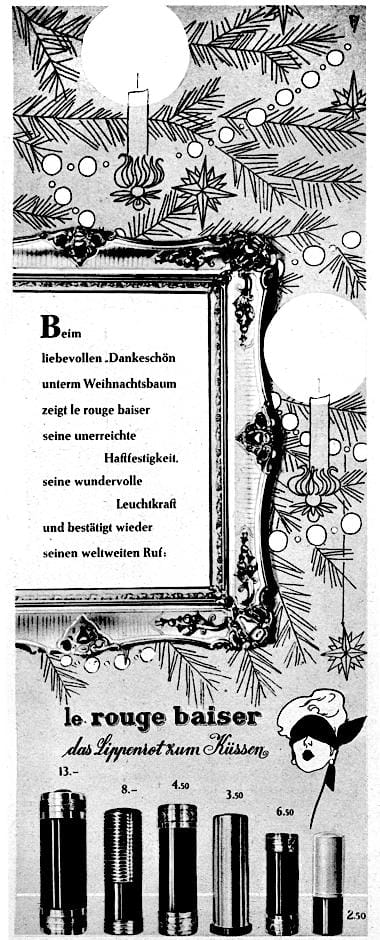
1954 Le Rouge Baiser in a range of lipstick cases (Germany).
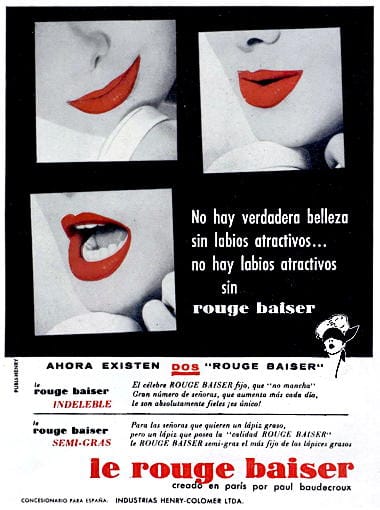
1961 Le Rouge Baiser Indelible and Le Rouge Baiser Semi-Gras (Spain).
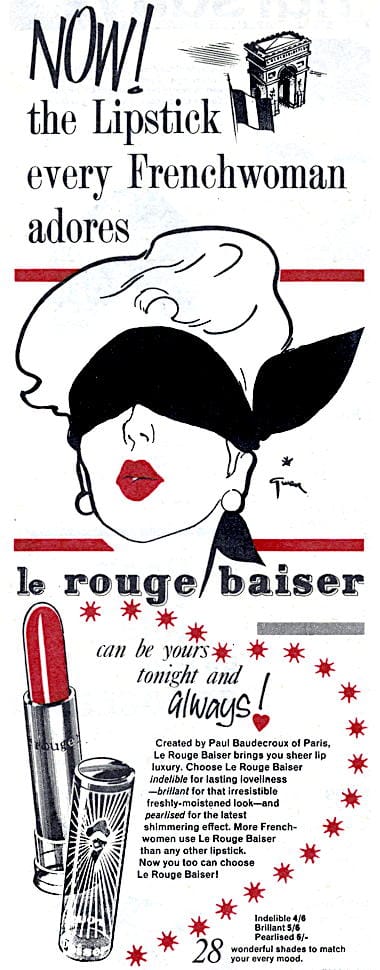
1963 Le Rouge Baiser lipstick (UK).
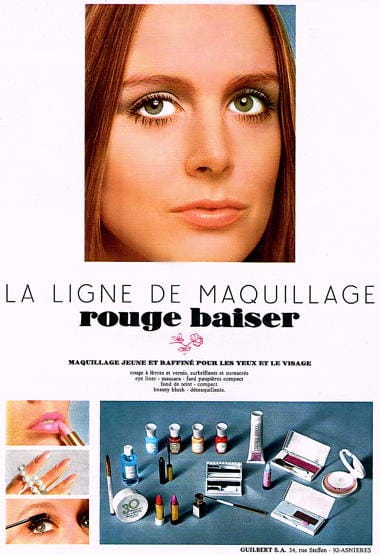
1970 Rouge Baiser make-up range.